
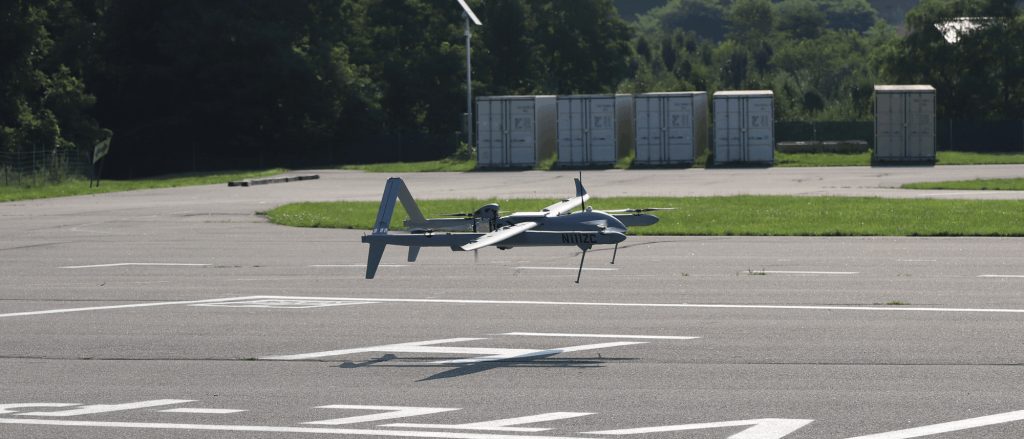
Textron Systems Corporation and the Mid-Atlantic Aviation Partnership at Virginia Tech have completed the first uncrewed aircraft transit between two vertiports through commercial civilian airspace. The cross-state demonstration covered nearly 150 nautical miles using the Aerosonde Mk. 4.7 VTOL platform, linking research facilities in western Virginia to industrial assembly hubs in the east.
Flight Profile and Airspace Integration
The aircraft launched vertically from a designated vertiport at the Virginia Tech Transportation Institute in Blacksburg, Virginia. Over a two-and-a-half-hour transit, the aircraft navigated non-segregated commercial airspace, concluding with a vertical recovery at Textron Systems’ 38,000-square-foot Aerosonde Center of Excellence in Blackstone, Virginia.
The mission was conducted in direct support of the Virginia Advanced Air Mobility Smart Airspace Program. Led by the Mid-Atlantic Aviation Partnership, one of seven FAA-designated UAS test sites, the initiative focuses on operational data gathering to support routine uncrewed logistics and Advanced Air Mobility operations within the National Airspace System without relying on segregated flight corridors.
Airframe Architecture and Hybrid VTOL Capability
The demonstration utilized the Aerosonde Mk. 4.7 VTOL, a hybrid system configured for runway-independent operations. The aircraft combines a dedicated multi-rotor lift assembly for vertical takeoff and landing with a fixed-wing pusher configuration for extended forward cruise.
- Propulsion and Power: Purpose-built heavy-fuel engine designed for high reliability and field maintainability.
- Payload Modularity: Compatible with over 40 payload variants, accommodating electro-optical/infrared sensors, electronic warfare equipment, and communications relays.
- Operational Heritage: Built on the broader Aerosonde family architecture, which has accumulated over 750,000 operational flight hours across land and maritime deployments.
Infrastructure and Commercial Scaling Implications
Most previous Advanced Air Mobility trials have been constrained to single-node flight loops, localized airport boundaries, or dedicated military test ranges. Executing a point-to-point transit between two purpose-built vertiports demonstrates the maturity of ground handling procedures, air traffic management deconfliction, and terminal area transitions.
As regulatory bodies and regional authorities refine beyond-visual-line-of-sight standards, validation flights of this distance establish baseline operational requirements for regional cargo networks, critical asset inspection, and autonomous logistics corridors.