
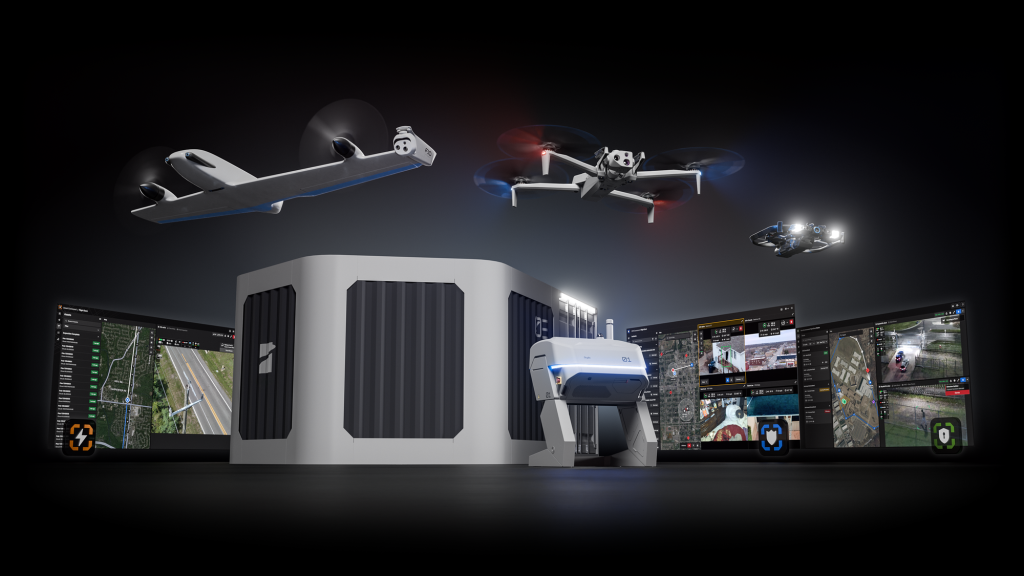
Skydio has officially broken out of its multirotor architecture. At its annual Ascend conference, the California drone manufacturer unveiled the F10 Lightrunner, a high-speed autonomous fixed-wing aircraft paired with a multi-bay docking station dubbed MegaDock. The hardware transition targets the physical endurance and speed limitations inherent to quadcopters, providing a platform designed specifically for long-range autonomous inspections and Drone as First Responder (DFR) operations.
High-Speed Aerodynamics and Operational Envelope
Multirotors pay an unavoidable aerodynamic energy tax when traversing large geographical footprints. The F10 Lightrunner addresses this constraint through an aerodynamically sculpted foam-core airframe skinned in IP55-rated protective polymer. The aircraft achieves a top speed of 100 mph (161 km/h) and a continuous flight endurance of 120 minutes.
Operating with an operational radius of 30 miles (48 km), a single F10 launch station provides roughly 2,800 square miles of mission coverage. Skydio quotes a launch time of 20 seconds from cold standby to airborne, optimizing the airframe for time-critical emergency deployments across municipal and utility networks.
SideEye Optical Architecture
Fixed-wing aircraft present persistent camera obstruction challenges during banked turns and orbits. Skydio addressed this geometric constraint by placing the primary sensor gimbal directly on the wingtip, an arrangement designated the SideEye system.
Because the optical package sits outside the propeller plane and away from the fuselage line, banking turns do not occlude the camera view. The optical payload integrates telephoto, narrow-field, and thermal sensors with a continuous-roll gimbal mechanism. Integrated Electronic Image Stabilization counter-rotates the video stream in real time, keeping horizons level during aggressive loitering patterns.
Robotic Takeoff, Landing, and MegaDock Automation
Fixed-wing field deployments historically demand runways, nets, catapults, or skilled retrieval crews. Skydio eliminated ground logistics through a proprietary Robotic Takeoff and Landing (RTOL) mechanism utilizing a suction-based robotic gripper.
The companion MegaDock housing can store and charge up to five F10 aircraft simultaneously. The multi-bay footprint allows organizations to orchestrate sequential mission rotations, maintaining continuous aerial coverage over critical infrastructure without waiting for single-drone recharge cycles. Command and control links rely on onboard Fusion+ dual-cellular bonding, aggregating independent commercial LTE and 5G connections for resilient Beyond Visual Line of Sight (BVLOS) streaming.
Fixed-Wing Autonomy and Enterprise Deployment
Navigation on the F10 is governed by Foresight, an autonomy engine calibrated specifically for fixed-wing trajectory calculations. Six fuselage- and wing-integrated optical navigation cameras provide obstacle detection up to 300 feet away, dynamically re-routing flight paths to maintain regulatory separation and airspace safety.
Alongside the hardware launch, Skydio introduced dedicated Asset Command and Security Command software suites, expanding upon its DFR Command interface. Handheld control is supported by the new Controller 2, featuring a 7-inch sunlight-readable display and 5.5 hours of operating battery life. Skydio expects commercial customer deliveries for the F10 Lightrunner and MegaDock ecosystem to commence in early 2027.