
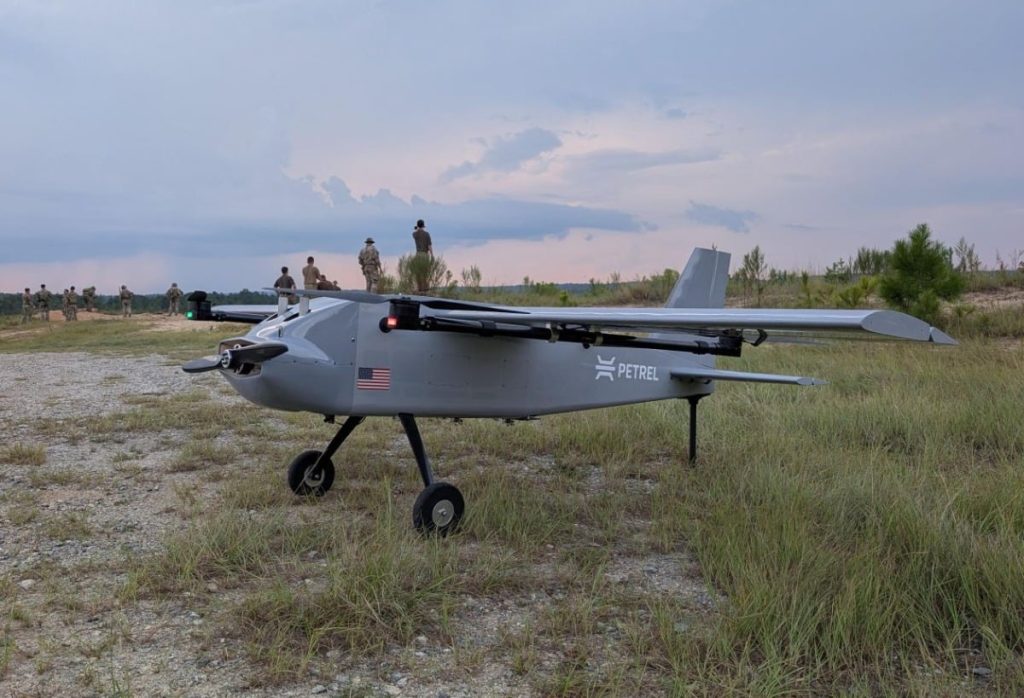
The operational ceiling for standard first-person-view strike drones is dictated by battery chemistry and line-of-sight radio links. Small multirotors drain their battery packs within fifteen minutes and force human operators dangerously close to forward engagement lines. Petrel Technologies and the U.S. Army’s 75th Ranger Regiment are evaluating an obvious mechanical workaround: an airborne mothership that carries strike drones into position before releasing them.
Extending Tactical Reach Without New Infrastructure
Recent live-fire evaluations conducted with the 75th Ranger Regiment put the company’s AERO Sky unmanned aerial system through operational trials as both a kinetic launch platform and an airborne relay node. The exercise follows earlier testing with the 101st Airborne Division at the Joint Readiness Training Center at Fort Polk, Louisiana, where the airframe demonstrated airborne deployment of armed FPV attack drones directly from flight.
The AERO Sky occupies the Group 3 UAS tier, bridging the operational gap between fragile man-portable quadcopters and multi-million-dollar tactical platforms like the MQ-9 Reaper. Featuring an 11-foot wingspan and a maximum takeoff weight of approximately 100 pounds, the aircraft combines vertical takeoff and landing (VTOL) rotors with a fixed-wing pusher configuration. This layout eliminates the need for pneumatic catapults, capture nets, or prepared runways, allowing single-operator deployment in austere terrain within four minutes.
Low-Cost Composites and Payload Economics
Petrel constructs the airframe from a composite blend of carbon fiber and structural balsa wood. This manufacturing choice keeps the unit flyaway cost around $90,000 while maintaining a payload capacity between 30 and 50 pounds. Powered for six to eight hours of loiter time, the airframe carries external pylons designed to release sub-tier loitering munitions and attack drones directly into terminal strike corridors.
By using a Group 3 mothership to ferry sub-tier strike drones across contested airspace, assault forces circumvent the severe range and endurance limits of small multirotors. Instead of burning battery capacity during transit, parasite drones conserve their full energy budget for terminal maneuvering and target acquisition.
ATAK Integration and Airborne Mesh Relays
Carrying munitions is only half the tactical equation. The AERO Sky simultaneously operates as an elevated communications relay, maintaining command-and-control links for ground teams operating beyond direct visual line of sight. The onboard avionics integrate directly with the Android Team Awareness Kit (ATAK) tactical mapping architecture.
Depending on radio frequency conditions and local jamming density, the system dynamically routes telemetry and video across:
- Tactical mesh radio networks for dismounted ground assault elements.
- Commercial and military satellite data links for rear-echelon command nodes.
- Cellular LTE infrastructure when operating in semi-permissive or hybrid environments.
Decoupling Operators from the Strike Vector
Modern electronic warfare on symmetric battlefields has rendered static ground control stations and predictable drone launch points high-priority targets. Russian and Ukrainian combat data from the past four years demonstrates that the moment an FPV transmitter fires up, counter-battery radar and RF triangulation make the pilot’s trench hazardous within minutes.
Operating a cheap, long-endurance VTOL platform that acts as both an ATAK relay and an aerial launcher decouples the operator from the terminal strike vector. The flight crew can remain concealed miles behind terrain features or inside armored vehicles while the mothership penetrates the contested envelope and drops its munitions directly over the target zone.
The Shift Toward Hierarchical Drone Swarms
For special operations units like the 75th Rangers, the AERO Sky trials reflect a broader doctrine shift. Military aviation is steadily moving away from monolithic, exquisite drone systems toward layered, low-cost mothership architectures that can absorb attrition while extending the lethal reach of infantry squads. At $90,000 a unit, losing an airframe in contested airspace is an acceptable tactical trade for neutralizing high-value adversary assets.