
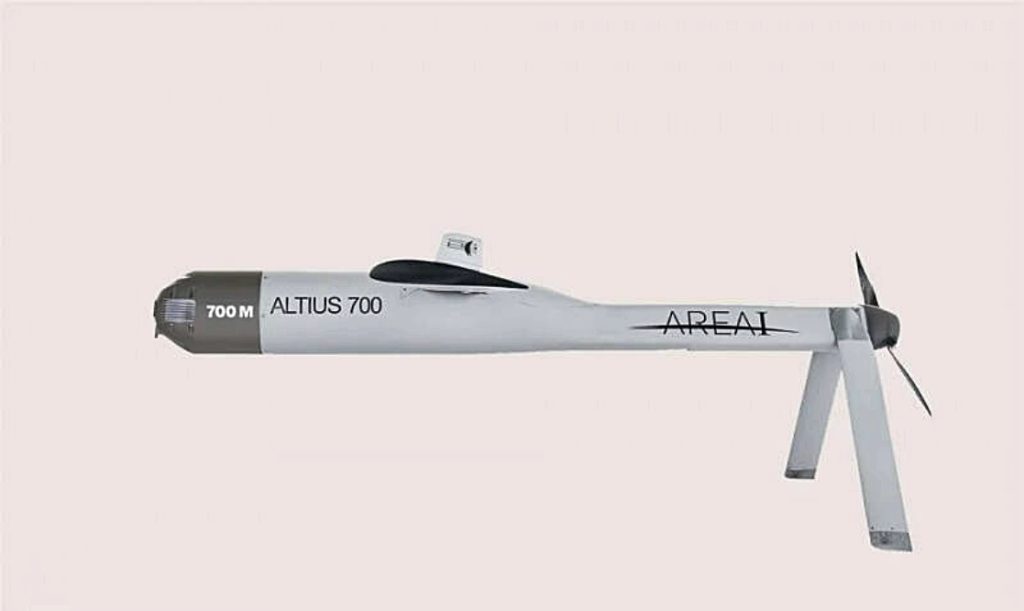
Taiwan’s Ministry of National Defence has formalized an NT$26.9 billion (approximately $847 million) contract with the United States to procure over 2,000 tube-launched loitering munitions and reconnaissance drones from Anduril Industries. The procurement covers 1,554 Altius-700M strike platforms and 478 Altius-600 ISR surveillance airframes, anchoring Taipei’s transition toward low-cost, high-density asymmetric denial in the Taiwan Strait.
Scaling the Altius Architecture
The contract follows an initial operational evaluation batch of 291 Altius-600M drones acquired under Taiwan’s baseline defense budget. In live-fire maritime exercises conducted earlier this year, the baseline 600M systems recorded a 100% target hit rate against sea-surface decoys. That operational validation cleared the path for the larger, capital-intensive acquisition funded through Taiwan’s special defense budget allocation.
The bulk of the new procurement focuses on the heavier Altius-700M. While the 600-series serves primarily as a multi-mission reconnaissance and light strike asset, the 700M carries a 33-pound (15 kg) class warhead. That payload matches the terminal armor-penetrating lethality of an AGM-114 Hellfire missile, engineered to defeat main battle tanks, amphibious landing craft, and hardened coastal radar nodes at extended standoff ranges.
Asymmetric Littoral Denial
Operating loitering munitions in the littoral domain shifts maritime defense economics. Traditional anti-ship cruise missiles like the Hsiung Feng III are costly, scarce, and vulnerable to preemptive strikes on fixed coastal batteries. By contrast, the Altius family relies on Common Launch Tubes (CLT) that deploy from light tactical vehicles, small coastal patrol craft, or rotary-wing aircraft.
The combination of 478 Altius-600 ISR units and 1,554 strike-configured 700Ms creates a distributed reconnaissance-strike complex. The ISR variants handle electronic warfare, target acquisition, and battle damage assessment, while passing targeting coordinates to autonomous strike swarms managed under unified command-and-control software.
Deployment and Fleet Integration
Deliveries are scheduled to commence in the fourth quarter of 2026, with full contract execution extending through June 2033. The Taiwan Army has structured a dedicated unmanned systems unit to manage operational doctrine, field maintenance, and swarm coordination across joint military commands.
As conventional airframes face mounting survivability concerns against integrated air defense networks, Taiwan’s massive inventory investment in tube-launched loitering munitions demonstrates a calculated commitment to distributed, expendable mass over legacy prestige platforms.