
Most autonomous cargo startups operate under a persistent delusion: that designing a clean-sheet airframe from scratch is a sensible way to deliver heavy payloads. It is not. Aviation certification is a bureaucratic meat grinder, and building a global supply chain for custom composite components usually ends in insolvency before the first commercial freight run. Robinson Helicopter Company is taking the opposite approach, and last week in Louisiana, they demonstrated why boring engineering beats Silicon Valley optimism.
The Mechanics of Retrofit Autonomy
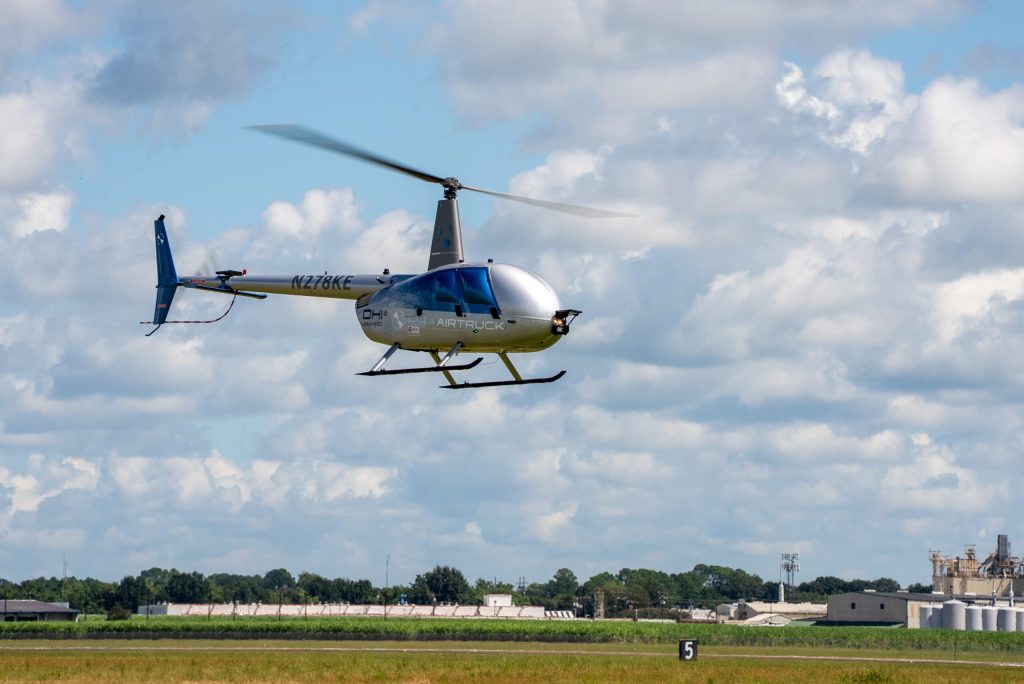
At Acadiana Regional Airport in New Iberia, Louisiana, Robinson Unmanned put its R44 AIRTRUCK through two days of operational trials. The platform performed repeated approaches, cargo loading, and precision touchdowns on an elevated deck built to mimic an offshore oil rig. The operations were managed by a lean two-person footprint consisting of a remote pilot in command and a single ground technician.
The AIRTRUCK is not an experimental prototype cobbled together in a venture-backed garage. It is a standard Robinson R44 airframe fitted with Rotor Technologies’ RPX autonomous flight system. By stripping out the cockpit interior and pilot controls, Robinson converted the ubiquitous civilian helicopter into an uncrewed workhorse capable of hauling up to 1,000 pounds of useful load across more than 60 cubic feet of cargo volume. Cruising at over 100 knots with a ceiling of 14,000 feet, the aircraft delivers performance metrics that multirotor delivery drones cannot touch without violating basic physics.
Leveraging Industrial Scale Over Clean-Sheet Dreams
The strategic brilliance here lies in Robinson’s production economics. Since acquiring Ascent AeroSystems in 2024 to anchor its uncrewed division, Robinson has pursued what CEO David Smith calls the “Era of Both.” The concept is simple: deploy identical airframes, shared parts bins, and established maintenance workflows for both crewed and uncrewed aviation.
When an offshore operator or military logistics unit breaks a tail rotor gear on an AIRTRUCK, they do not need to wait six months for a custom machining batch from a boutique drone startup. They order a standard R44 replacement part from an existing catalog supported by hundreds of certified Part 145 repair stations worldwide. The Aviation Academy of Louisiana (AAL) and offshore giant PHI Aviation observed the New Iberia trials precisely because this logistics footprint already exists in the Gulf of Mexico.
Solving the High-Risk Maritime Leg
Offshore platform resupply has always been among the most dangerous flight profiles in commercial rotary-wing aviation. Transferring critical drilling hardware or replacement turbine components through squalls and turbulent marine boundary layers puts human aircrews at constant risk. The AIRTRUCK solves this not by inventing a radical new lift mechanism, but by removing the meatware from the cockpit on hazardous transport legs.
The implications extend well beyond Gulf oil fields. The Pentagon’s ongoing push for distributed maritime logistics in contested Pacific theaters requires high-cadence, low-cost autonomous resupply. With Robinson already delivering tactical systems under the Drone Dominance Program, pairing sub-250g micro-drones with 1,000-pound unmanned helicopters creates a coherent operational pipeline. Autonomy is only valuable when the hardware actually flies, scales, and gets repaired without fanfare. In New Iberia, Robinson demonstrated that the fastest route to heavy-lift autonomy is simply automating the airframe that already owns the sky.