
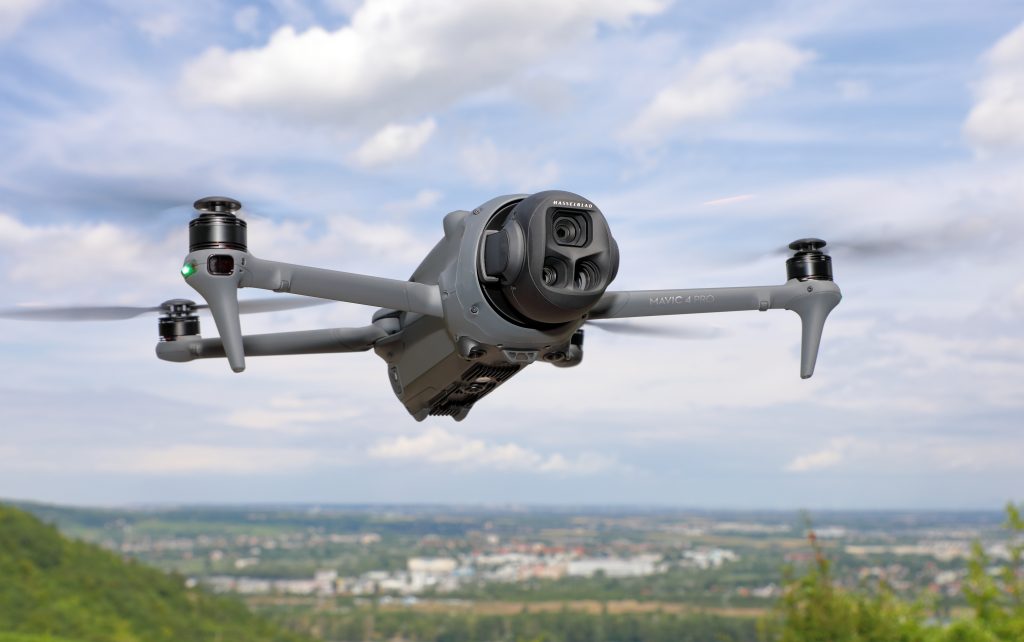
The consumer drone industry has spent the last year in a state of nervous expectation. For months, leaked photographs and patent filings hinted at a platform that would represent more than just an incremental upgrade to the Mavic line. This morning, we have the official confirmation. The DJI Mavic 4 Pro has officially launched, and it brings with it a feature set that fundamentally changes how we think about aerial cinematography.
A Revolutionary Gimbal Design
The headline feature of the Mavic 4 Pro is undoubtedly its new infinity gimbal. For the first time on a folding consumer drone, the gimbal can rotate 360 degrees on its roll axis. This is not just a technical curiositiy. In practice, it means the Mavic 4 Pro can shoot native vertical video without any loss in resolution or sensor area. Mobile-first content creators have been asking for this for years, but the implementation here goes further than simple 90-degree flips. The ability to tilt up to 70 degrees upwards adds a perspective that was previously reserved for specialized FPV builds or the much larger Inspire 3.
By allowing the camera to look straight up, DJI has opened new doors for bridge inspections, ceiling surveys, and creative shots that use the underside of structures as a compositional element. The mechanical engineering required to keep such a complex gimbal stable in high winds is impressive. Even in sport mode, the footage remains remarkably level, a testament to the refined stabilization algorithms that DJI has perfected over the last decade.
The Hasselblad Powerhouse
Powering the vision of this drone is a triple-camera system that sets a new high-water mark for portable imaging. The main camera features a 4/3-inch CMOS Hasselblad sensor capable of 100 megapixel stills. While megapixel counts can often be a distraction, the raw files coming off this sensor show a level of detail and dynamic range that rivals dedicated ground-based professional cameras. The ability to shoot 6K video at 60 frames per second or 4K at a staggering 120 frames per second means this drone will find a home on film sets as a “B-cam” just as easily as it will in a travel photographer’s backpack.
The supporting cameras are equally capable. The 70mm medium telephoto and 168mm telephoto lenses have both seen sensor upgrades. The 168mm lens, in particular, now features a larger 1/1.5-inch sensor, making it much more useful in low-light conditions. Previously, these telephoto options felt like compromises in everything but the brightest sunlight. Now, they are legitimate tools for compression shots and wildlife photography where staying at a distance is a requirement.
The Elephant in the Room: US Availability
However, the celebration is tempered by a significant geopolitical hurdle. As of today, the Mavic 4 Pro has no confirmed US release date. Due to ongoing regulatory scrutiny and the recent legislative environment in Washington, DJI is prioritizing markets in Europe, Asia, and Australia. For American pilots, this creates a frustrating paradox. The world’s most advanced consumer drone is available to everyone except those in one of its largest traditional markets.
This delay is likely a strategic move by DJI to ensure compliance with evolving Remote ID and data sovereignty requirements. While American enthusiasts might be tempted to import units from overseas, we strongly advise caution. Without official support, warranty claims and insurance coverage become a nightmare. Furthermore, the software could potentially be geo-fenced if it detects operation in an unauthorized region. It is a waiting game that many are beginning to find tiresome.
Flight Performance and Endurance
On the technical side, the flight time has been pushed to a maximum of 51 minutes. In real-world testing, where wind and obstacle avoidance are factors, you can expect a solid 42 to 45 minutes of usable airtime. This is a meaningful jump from the Mavic 3 Pro. Those extra five to eight minutes are often the difference between getting the shot and having to return for a battery swap just as the light becomes perfect.
The obstacle avoidance system now uses a new generation of wide-angle vision sensors that provide complete 360-degree coverage without any blind spots. The APAS 6.0 software allows the drone to maintain smooth motion even in complex environments like dense forests or urban construction sites. It is less about preventing crashes and more about allowing the pilot to focus on the frame rather than the surroundings.
Market Competition
Where does this leave competitors like Autel or Skydio? Skydio has largely exited the consumer space to focus on defense and enterprise, leaving a vacuum that Autel has struggled to fill with its EVO series. The Mavic 4 Pro effectively cements DJI’s dominance in the high-end consumer and prosumer market. It is difficult to justify any other platform when the imaging capabilities are this far ahead of the pack. The only real threat to DJI’s crown is political, not technical.
Conclusion
The Mavic 4 Pro is a masterpiece of miniaturized technology. It offers professional-grade cameras, industry-leading flight times, and a gimbal design that feels like a glimpse into the future. For those living in regions where it is currently for sale, the decision to upgrade is an easy one. For those in the US, the wait continues. Regardless of where you live, the Mavic 4 Pro proves that the era of the flying camera is only just beginning. It is a refined tool for a new generation of visual storytellers.