
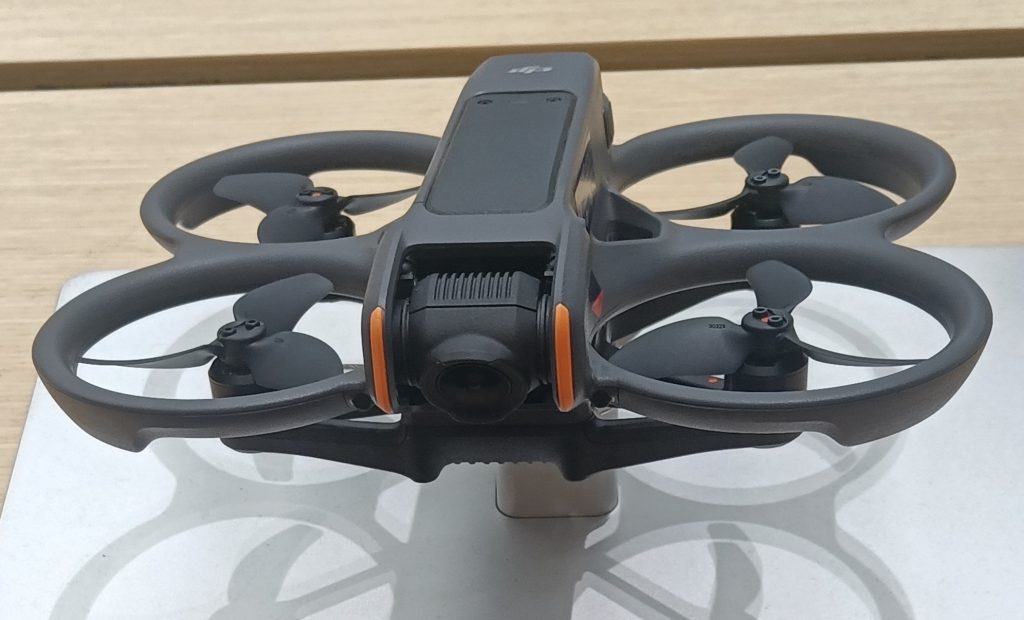
A New Kind of Drone
The DJI Avata 360 went on sale globally on March 26, 2026, and landed on US Amazon shelves this morning. It is the drone people have been speculating about since DJI dropped a cryptic teaser back in early March showing fireworks, city dives, and a “tiny planet” shot that bent the whole skyline into a sphere. That footage was impossible with a normal drone camera. It was a clue.
The Avata 360 is DJI’s first true 360-degree drone, and it arrives about three months after Insta360’s sub-brand Antigravity launched the A1 and claimed the title for itself. DJI’s response is faster, cheaper, more flexible, and backed by years of FPV drone development. The question is whether it actually delivers in the air.
What It Does, In Plain Terms
The concept is simple: instead of pointing a camera at your subject while you fly, you capture everything. Two lenses stitch together to record a full 8K spherical image at 60 frames per second. You fly the whole scene, land, and then choose your shot in editing. Pan, tilt, rotate, zoom, reframe. A single flight becomes a library of angles.
That has real practical appeal. No more realising mid-flight that you framed the shot wrong. No more missing the moment because you were looking the other direction. If you were in the air when it happened, you got it.
But DJI did something the A1 does not: they put those lenses on a swiveling gimbal. Push them to face forward and the Avata 360 becomes a standard FPV drone, recording in traditional 4K with the full suite of DJI’s flight modes, tracking, and stabilisation. One aircraft, two entirely different use cases.
The Specs That Matter
Here is what DJI is shipping:
- 8K/60fps spherical video (the Antigravity A1 caps at 8K/30fps)
- 120-megapixel stills in 360-degree mode
- 1-inch-equivalent sensors with wide aperture lenses
- 18 m/s top speed in Sport mode (about 65 km/h or 40 mph)
- 23 minutes of quoted flight time
- 20 km maximum range in ideal conditions
- 42GB internal storage (good for around 30 minutes of 8K footage, no SD card required)
- Wi-Fi 6 offload transfers at roughly 1GB per 10 seconds
- Omnidirectional obstacle sensing, including in low-light conditions
- Built-in propeller guards (not sold separately like most competitors)
- Replaceable front lens for easy repair after minor impacts
- 455g total weight
That weight is worth flagging. At 455g, the Avata 360 sits well above the 250g line that triggers registration requirements in Australia, the UK, much of Europe, and several other jurisdictions. The Antigravity A1 is lighter and foldable, giving it an edge for travel and places with strict sub-250g rules. The Avata 360’s trade-off is structural rigidity and those built-in guards, which do make it a tougher aircraft to fly in tighter spaces.
Day-One Firmware Already Expanded the Feature List
DJI shipped a substantial firmware update (v01.00.0100) alongside the drone’s launch, which is worth noting because it meaningfully improves what the aircraft can do out of the box.
The key additions: Sport mode now hits 18 m/s (up from a lower initial ceiling), FocusTrack gained automatic detection for cycling and skiing subjects, head tracking in 360-degree mode now has reduced latency and roll angle control, and DJI added Panorama Stitching Calibration to improve the accuracy of 360-degree stitching at the seams. There are also new 2.7K video options across multiple frame rates in single-lens mode, giving creators more flexibility when they do not need the full 8K resolution.
Playback optimisation for 8K/30fps panoramic footage in goggles also got a latency reduction, which matters a lot for immersive FPV viewing. These are not flashy headline features, but they address the things that define day-to-day usability.
Pricing: The Number That Changes Everything
This is where DJI has been aggressive. The Avata 360 starts at €459 in Europe (roughly $490-$540 depending on importer markups) for the drone only. The Fly More Combo, which adds an RC 2 controller, extra batteries, and a carrying bag, lands at €939. The top-tier Premium Combo with Goggles N3 and RC 2 is €1,159.
Compare that to the Insta360 Antigravity A1, which launched at $1,599 for its base bundle. DJI’s most comparable combo, the Motion Fly More package with Goggles N3, an RC Motion 3, and extra batteries, is €939, which converts to roughly $1,100. You are getting DJI goggles, a motion controller, and the drone itself for less than the A1 costs alone.
That pricing gap is not a coincidence. DJI entered the 360 drone market knowing exactly what the A1 cost, and priced the Avata 360 to make the A1 look expensive. Insta360 had already been running promotional discounts on the A1 before the Avata 360’s launch. That tells you what they were anticipating.
Avata 360 vs. Antigravity A1: How They Actually Compare
The A1 was a genuine achievement when it launched in December 2025. It was the first drone to put a true 360-degree camera in the sky in a package most people could actually use. But The Verge’s hands-on comparison found the Avata 360 pulling ahead in several ways:
- Video quality: DJI’s larger sensors, wider apertures, and 8K/60fps (vs the A1’s 8K/30fps cap) give it a meaningful edge for motion-heavy footage
- Speed: 18 m/s vs the A1’s 16 m/s, which doesn’t sound dramatic but noticeably reduces that floaty, unresponsive quality the A1 can have at pace
- Range: 20km vs approximately 10km for the A1
- Control options: The Avata 360 supports motion controllers, traditional twin-stick RC, smartphone app, or goggles. The A1 is more limited
- Single-lens mode: Only the Avata 360 can switch to forward-facing FPV. The A1 is 360-only because its cameras are fixed
Where the A1 holds advantages: it is foldable and lighter, both of which matter for travel and for flying legally in sub-250g jurisdictions. If you are in Australia and want to keep things simple under the CASA recreational drone rules, the A1’s weight is a practical benefit.
The US Situation Is Complicated
American buyers are dealing with a more specific set of circumstances. The Avata 360 received FCC certification in December 2025, making it the last DJI drone to clear that process before the de facto US import restrictions took hold. DJI is not officially selling the Avata 360 through its own US channels, but it is available via Amazon’s third-party marketplace from importers, with US availability going live this morning (March 30).
The Verge’s review called it potentially “the last DJI drone you may ever be able to legally buy in the US.” Whether that is accurate depends on how the DJI-FCC lawsuit plays out, but the Avata 360 sits in a unique legal position: FCC-certified, importable, and flyable under Part 107 and recreational rules, but without DJI’s direct US retail support. If DJI warranty and official service matter to you, that is a real consideration.
For Australian, European, and most other international buyers, none of that applies. Stock is expected to ship from April 9 in most markets.
Who Should Buy It
The Avata 360 makes sense for a few distinct types of buyers.
Content creators who fly regularly and want to stop missing shots due to framing decisions made mid-flight. The 360-then-choose-later workflow is genuinely useful for weddings, real estate, travel content, and any situation where you cannot predict exactly where the action will be.
FPV pilots who want to expand without buying a second aircraft. The single-lens mode is a real FPV experience, not a compromise, and the compatibility with DJI RC 2, Goggles 3, and FPV Remote Controller 3 means it slots into existing DJI FPV setups.
Newcomers to FPV who find standard FPV intimidating. The omnidirectional obstacle avoidance, built-in guards, and assisted flight modes remove most of the risk that scares off beginners. You can be in the air taking usable footage within minutes.
If you are already heavily invested in the Antigravity ecosystem, or you need to stay under 250g for regulatory reasons, wait. But for most people looking at a 360-degree drone purchase in 2026, the Avata 360 is the answer. The A1 had about 90 days as the only serious option in this category. That window has closed.
The Bottom Line
DJI took longer than expected to get into the 360-drone space, but the Avata 360 arrives with a clear spec advantage, aggressive pricing, and the full weight of DJI’s software and ecosystem behind it. The day-one firmware update alone shows the aircraft is getting continuous development attention from launch.
At €459 drone-only (with international buyers looking at April shipping), it is not a budget purchase. But it is the most complete 360-degree drone available right now, and the price gap relative to the competition is hard to argue with. If aerial 360-degree video has been on your radar, this is the product the category has been waiting for.