
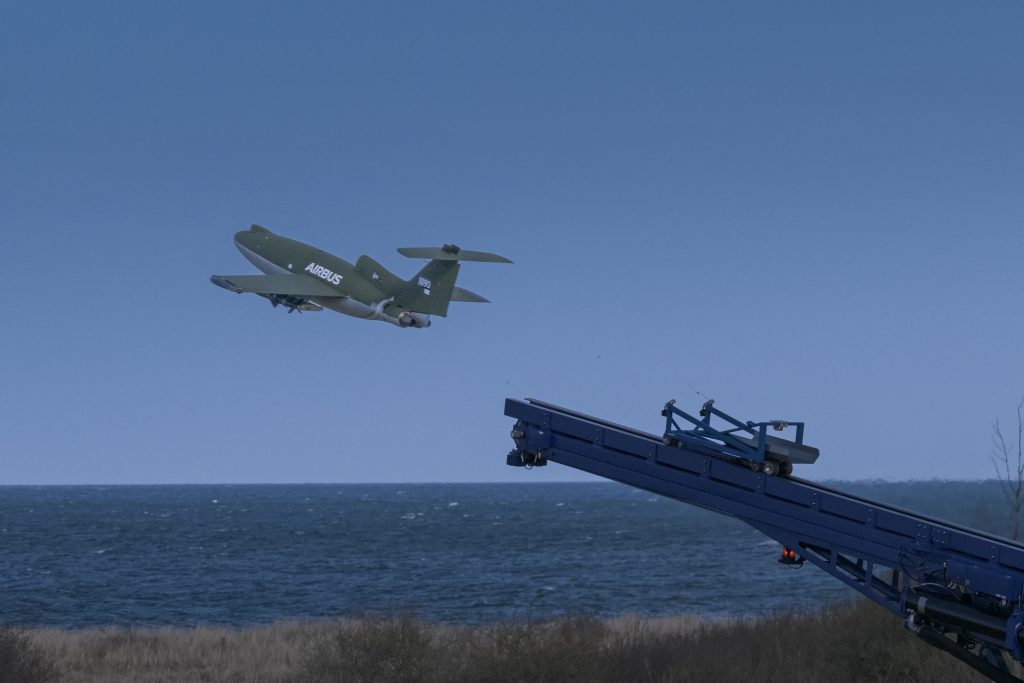
On 30 March 2026, Airbus Defence and Space ran a test flight in northern Germany that pointed straight at a problem every modern military is desperate to solve. A modified Do-DT25 target drone, rebranded as the Bird of Prey, tracked, classified, and fired at a simulated kamikaze drone using a low-cost Mark I air-to-air missile. It did not rely on a human pilot. It did not fire an expensive surface-to-air missile. It handled the entire engagement autonomously.
The nine-month sprint from concept to flight tells you everything about how fast the counter-drone space is moving. Militaries worldwide are burning through inventory shooting down thousand-dollar drones with million-dollar interceptors. Bird of Prey is Airbus’s answer to the cost imbalance that has defined modern drone warfare.
The Economics Problem Behind Counter-Drone Warfare
The math is brutal and it explains why this programme exists. A Shahed-136 loitering munition costs roughly $20,000 to $50,000. A Patriot missile runs two to four million dollars. Even a man-portable system like the Stinger costs $120,000 per shot. Fire enough of these at cheap incoming drones and you drain your own inventory before the enemy runs out of targets to send.
Ukraine has been making this point clear for two years. Russia sends swarms of Geran-2 drones against Ukrainian infrastructure. Ukraine has learned to shoot back with everything from machine guns to modified MiG-29s. Neither approach scales well.
Bird of Prey attacks the problem from a different angle. The interceptor drone costs far less than any traditional air defense missile. The Mark I missiles it carries weigh under 2 kg each and cost a fraction of a conventional interceptor. The whole system is reusable. Fire a Mark I, reload, fly again. The cost per engagement drops into territory that actually works against sustained drone attacks.
What the Bird of Prey Actually Is
The prototype is a modified Do-DT25, a target drone Airbus already builds. Wingspan sits at 2.5 metres. Length is 3.1 metres. Maximum takeoff weight is 160 kg. Small enough to deploy from a rail launcher. Large enough to carry a meaningful weapons load.
The test version carried four Mark I air-to-air missiles, one under each wing station. Airbus says the operational model will carry up to eight. The Mark I missile itself is noteworthy. Developed by Estonian defense startup Frankenburg Technologies, it measures 65 centimetres, flies at high-subsonic speeds, and uses fire-and-forget guidance. Range extends to 1.5 kilometres. The warhead is a fragmentation design built for proximity detonation against small aerial targets.
At under 2 kg per missile, the Mark I is the lightest guided interceptor on record. That matters because payload weight dictates everything about a drone’s range, endurance, and sortie flexibility. Eight missiles at that weight is a credible loadout for a 160 kg platform.
Autonomous Engagement, Not Remote Control
The March 30 test was not someone on the ground flying the interceptor like a racing drone. Airbus described the scenario as autonomous. The Bird of Prey searched, detected, classified, and engaged the target without manual piloting input for the intercept itself.
That distinction matters for the operational model. A counter-drone system that requires a skilled operator per interceptor does not scale against swarms. A system that can be given a patrol area, an engagement authority, and left to prosecute targets is something entirely different. The line between autonomous air defense and autonomous strike has been a political third rail in European defense circles for years. Airbus has now walked closer to it than most Western companies dare.
The system integrates with NATO-compatible command and control architecture through Airbus’s Integrated Battle Management System. In practice, this means Bird of Prey slots into existing air defense grids as a mobile point defense layer. It catches the small, low-altitude, low-signature threats that slip through radar screens designed for larger aircraft, cruise missiles, or ballistic trajectories.
The Competition Is Growing Fast
Airbus is not alone in this space. The counter-UAS interceptor market has become one of the most crowded and urgent corners of the defense industry. Here is what else is happening right now.
XTEND and ParaZero announced a partnership to build autonomous drone interception systems that physically capture hostile drones mid-air using nets rather than explosives. That approach avoids debris falling onto populated areas. Terra Drone invested in Ukraine-based Amazing Drones and launched the Terra A1 interceptor, which claims a 32 km range and 300 km/h top speed designed for countering loitering munitions at lower cost than missiles. DroneShield opened a European headquarters in Amsterdam to expand its counter-drone electronics business across the continent.
The common thread across all of these systems is cost. Every company in this space is trying to flip the economics equation. The side that can neutralize cheap drones with cheap interceptors wins the attrition war. The side that keeps using million-dollar missiles against thousand-dollar drones loses.
What This Means for European Air Defense
Bird of Prey fits into a broader European effort to build indigenous counter-drone capability after years of dependence on American systems. The timing is deliberate. Kamikaze drone attacks on infrastructure in the Middle East have drawn sharp attention from NATO planners. The conflict in Ukraine has generated more data on drone warfare than any conflict in history. European defense ministers are reading those reports and writing cheques.
Airbus plans additional test flights through 2026, including live warhead demonstrations. Those tests will determine whether the system can reliably engage multiple targets per sortie, whether the Mark I missile’s proximity fuse works as designed against realistic low-signature targets, and whether the autonomous classification system can distinguish between threats and non-threats in contested airspace.
If those tests go well, expect European armed forces to move quickly. Poland, Germany, the Baltic states, and Romania all have active counter-drone procurement programmes. Bird of Prey checks boxes that existing options do not: European built, NATO-compatible, reusable, and designed for the specific threat profiles these countries face.
The Bigger Picture
Every defense technology that enters service shapes how the next conflict gets fought. The F-35 was designed to fight high-end air superiority battles. The Reaper was designed for persistent surveillance and targeted strikes in permissive airspace. Bird of Prey is designed for something different. It exists because the low end of the threat spectrum has become the most dangerous part of it.
Iran and its partners have demonstrated that cheap, expendable drones can threaten critical infrastructure and complicate air defense planning for wealthy nations. Ukraine has demonstrated that counter-drone capability is no longer optional. It is the baseline requirement for surviving modern conflict.
Bird of Prey will not singlehandedly solve the kamikaze drone problem. No single system will. But it adds a credible layer to integrated air defense, and it does so at a cost point that sustains prolonged operations. That is the metric that actually matters.
Key Specifications
| Parameter | Value |
|---|---|
| Platform | Modified Do-DT25 target drone |
| Wingspan | 2.5 metres |
| Length | 3.1 metres |
| MTOW | 160 kg |
| Missiles (test) | 4 x Mark I air-to-air |
| Missiles (operational) | Up to 8 x Mark I |
| Missile weight | < 2 kg each |
| Missile length | 65 cm |
| Missile range | Up to 1.5 km |
| Missile speed | High-subsonic |
| Guidance | Fire-and-forget |
| Autonomy | Search, detect, classify, engage |
| NATO integration | Via IBMS command and control |