
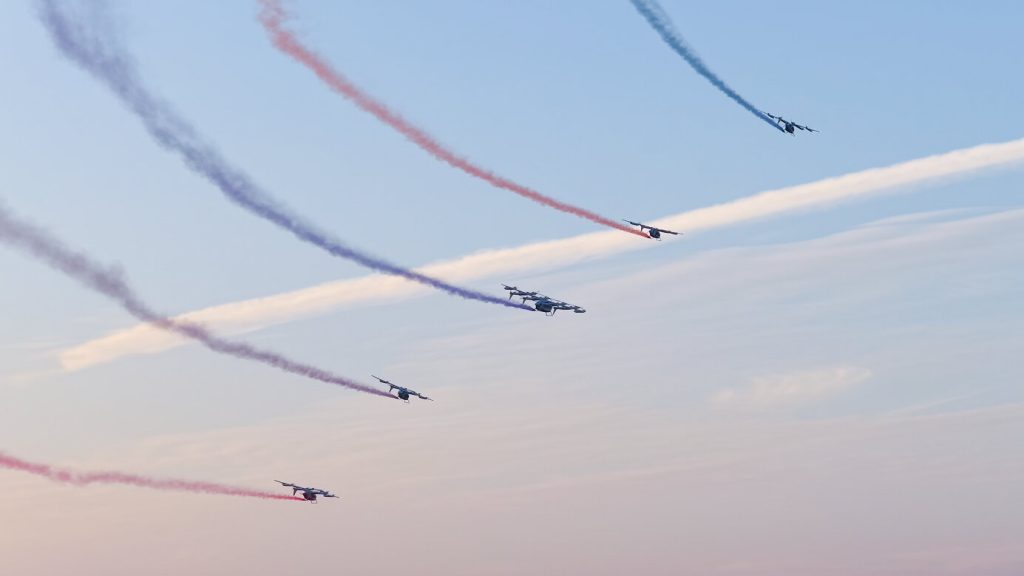
AutoFlight has completed an autonomous formation flight involving five electric vertical takeoff and landing (eVTOL) aircraft across two distinct weight classes at its Bailian Lake Flight Test Base in Kunshan, China. The sortie, conducted over demonstrations on October 31 and November 1, 2026, lasted 47 minutes and covered more than 133 kilometers without manual pilot intervention.
Heterogeneous Fleet Architecture
The five-aircraft formation integrated two separate weight categories and three operational configurations:
- Lead Platform: One 5-ton V5000 Matrix heavy-lift eVTOL aircraft acting as the primary navigation anchor.
- Logistics Platforms: Two 2-ton V2000CG CarryAll cargo eVTOL aircraft designed for regional freight transport.
- Specialized Platforms: Two 2-ton V2000CGF CarryAll firefighting eVTOL aircraft configured with payload systems for emergency response.
Coordinating aircraft with differing mass, aerodynamic profiles, wing loadings, and inertia responses requires continuous automated flight control adjustments. AutoFlight stated that the onboard systems maintained designated horizontal and vertical separation margins throughout the 47-minute profile, despite encountering elevated wind conditions during the November 1 flight leg.
Autonomous Flight Control and Separation Logic
Unlike single-platform autonomous operations, multi-aircraft formation requires real-time vehicle-to-vehicle (V2V) telemetry links, distributed spatial deconfliction algorithms, and dynamic trajectory synchronization. The lead V5000 Matrix traversed 133 kilometers while trailing aircraft matched velocity vectors, altitude offsets, and turn rates autonomously.
The demonstration builds upon AutoFlight’s earlier three-aircraft formation trial completed in May 2026, which paired one V5000 with two V2000-series units to validate basic control interfaces. Expanding the formation to five units across two weight classes tests the scalability of the automated separation stack in multi-tier airspace.
Infrastructure and Operational Context
The Kunshan demonstrations included live operations adjacent to Sunship, AutoFlight’s water-based vertiport facility on Dianshan Lake. The company has positioned water-based vertiports as modular nodes to reduce land acquisition costs and airspace constraints near coastal and riparian population centers.
Earlier in the week, Singapore aircraft charter operator JC Aviation signed a memorandum of understanding with AutoFlight covering the planned procurement of 260 V2000-series cargo, firefighting, and passenger eVTOLs, alongside 10 Sunship vertiport platforms scheduled for delivery between 2026 and 2029.
Implications for Low-Altitude Traffic Management
Commercial deployment of Advanced Air Mobility (AAM) networks depends on autonomous multi-vehicle scheduling and trajectory tracking rather than manual pilot coordination. Demonstrating autonomous spacing among heterogeneous eVTOL models in real wind conditions provides baseline empirical validation for high-density low-altitude corridors, mixed-fleet cargo dispatch, and uncrewed emergency response operations.