
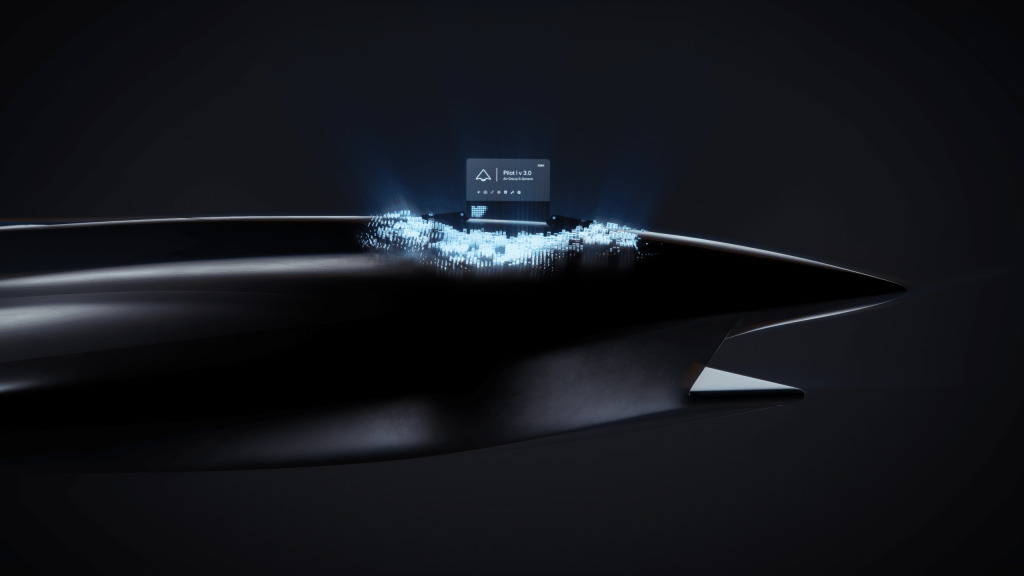
Shield AI has rolled out the first full-scale prototype of its X-BAT autonomous combat aircraft, designated serial number 001 with civil registration N228XB. The airframe is transitioning from the company’s primary integration facility in Frisco, Texas (X-Forge 1), to its flight test and sustainment center at Newton City-County Airport in Kansas (X-Forge 2) to prepare for initial flight demonstrations before the end of 2026.
Runway-Independent Jet Architecture
Unlike conventional Collaborative Combat Aircraft (CCA) designs that depend on paved runways and arresting gear, X-BAT utilizes a tail-sitting vertical takeoff and landing (VTOL) configuration. The single-engine stealth airframe is powered by a GE Aerospace F110 afterburning turbofan equipped with a thrust-vectoring nozzle system. Vertical launch and recovery occur via mobile launch vehicles, shipboard flight decks, or unprepared forward expeditionary sites.
The operational premise addresses a core vulnerability in modern Pacific theater war games: fixed airbases and long runways are primary targets for long-range ballistic and cruise missiles. By removing runway dependency, the aircraft can disperse across maritime assets, including amphibious assault ships (LHAs, LHDs), expeditionary sea bases (ESBs), and standard aircraft carriers (CVNs), without requiring catapults or arresting wires.
Payload Capacity and Aerodynamic Envelope
X-BAT is substantially larger than early Increment 1 CCAs. Key technical specifications include:
- Propulsion: GE Aerospace F110 afterburning turbofan with thrust-vectoring control for low-speed hover and vertical-to-horizontal transition.
- Payload bays: Internal weapons bays sized to match F-35 volumetric capacity, supporting up to 2,000-pound class precision munitions, air-to-air interceptors, and stand-off strike weapons.
- Range and Endurance: Objective combat radius of 1,000 nautical miles, with ferry range exceeding 2,000 nautical miles.
- Sensor Integration: Active electronically scanned array (AESA) radar and electronic warfare systems developed in partnership with RTX (Raytheon).
- Deck footprint: Designed with a 3:1 spatial efficiency compared to legacy manned fighters, tripling potential airframe density on existing naval decks.
Autonomy and Edge Execution
Flight control and tactical decision-making are driven by Shield AI’s proprietary Hivemind software architecture. Hivemind is designed to execute multi-agent tactics, route planning, and combat maneuvers without continuous human input or reliance on external communications and satellite navigation networks.
The system operates locally on edge computing hardware within the airframe, maintaining tactical cohesion during high-intensity electronic warfare and GPS-denied scenarios. This design separates X-BAT from remotely piloted drones that require uninterrupted line-of-sight or satellite data links to remain operational.
Program Backing and Production Timeline
Total public and private development funding for X-BAT has reached $400 million. This includes recent Other Transaction authority modifications from the U.S. Navy and backing via the Defense Innovation Unit under the Runway Independent Maritime Expeditionary Strike (RIMES) project.
Initial hover, transition, and aerodynamic validation flights at Newton City-County Airport will focus on vertical flight stability and thrust-vectoring dynamics. Shield AI plans to fly missionized prototypes in 2028, followed by serial production at its planned facility in Des Moines, Washington (X-Forge 3), starting in 2029.