
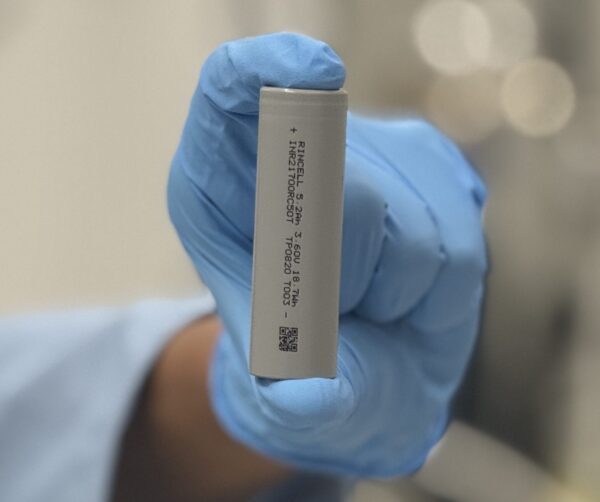
Fremont-based battery developer Rincell has introduced the RC50T, an NDAA-compliant tabless 21700 lithium-ion cell engineered specifically for demanding uncrewed aerial vehicle (UAV) flight profiles. The cell is designed to deliver sustained high-current output during high-load mission segments such as vertical takeoff, aggressive climb profiles, and high-G maneuvers.
Performance Specifications and Tabless Design
The RC50T utilizes a silicon-graphite lithium-ion chemistry packaged in a standard 21700 cylindrical format. It delivers a continuous discharge rate of 100A and a peak pulse capability of 150A. Energy density is rated above 265 Wh/kg with a nominal capacity of 5.2Ah at 3.6V.
The tabless internal architecture reduces internal resistance down to 3 to 4 milliohms. In multirotor and eVTOL applications, lower impedance translates to reduced thermal dissipation under load, allowing more stored chemical energy to reach the electronic speed controllers and motors as usable electrical power rather than waste heat. The cell also supports charge rates up to 15A, enabling rapid battery turnaround between operational sorties.
High-Power vs. Long-Endurance Trade-Offs
The RC50T operates alongside Rincell’s existing RC50 cell, a 5.0Ah unit optimized for endurance. While the RC50 delivers higher energy density at 276 Wh/kg and a rated cycle life exceeding 1,000 cycles at 5C continuous discharge, the RC50T prioritizes peak current capability over cycle longevity, offering an estimated lifespan of 500 cycles.
Operating temperature parameters for both cells span -20 to 60 degrees Celsius (-4 to 140 degrees Fahrenheit), covering standard military and industrial operating environments without requiring active pre-heating in moderate sub-zero conditions.
Defense Supply Chain Compliance
Rincell developed the cell under venture backing from In-Q-Tel, the U.S. Department of War, and the California Energy Commission. Production is currently active, with initial volume manufacturing located in India and an additional domestic U.S. manufacturing facility slated for late 2027.
Full National Defense Authorization Act (NDAA) compliance positions the RC50T as a drop-in power source for Western defense contractors and commercial fleet operators seeking to decouple propulsion supply chains from restricted foreign cell manufacturers.