
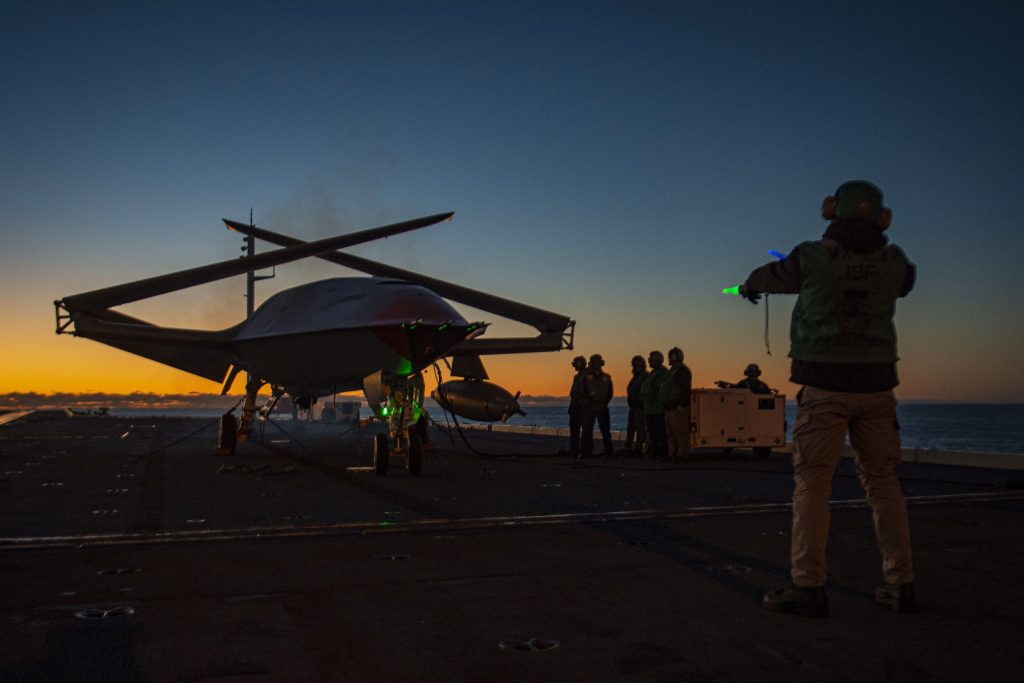
The United States Navy has committed its first production dollars to operational carrier-based uncrewed aviation. Under a fixed-price incentive contract valued at $562 million, Boeing will manufacture Lot 1 Low-Rate Initial Production (LRIP) units of the MQ-25A Stingray uncrewed aerial refueling tanker.
The contract covers three Lot 1 air vehicles and funds the acquisition of long-lead components and subassemblies for a subsequent three Lot 2 aircraft. Initial deliveries under Lot 1 are scheduled to commence in 2029, formally transitioning the Stingray from a flight test initiative into a shipboard operational asset.
Relieving the Super Hornet Tanker Burden
The MQ-25A addresses a structural inefficiency in carrier air wing operations. For decades, the Navy has relied on F/A-18E/F Super Hornets equipped with aerial refueling stores to serve as tactical “buddy tankers.” This approach routinely consumes 20 to 30 percent of strike fighter sorties simply moving fuel between aircraft, rapidly burning through structural flight hours on frontline airframes performing basic fuel transfers.
By offloading the organic tanking requirement to the MQ-25A, Carrier Air Wings (CVWs) can reclaim those Super Hornet sorties for dedicated strike, air superiority, and electronic warfare missions. The Stingray is engineered to deliver up to 15,000 pounds of fuel at a mission radius of 500 nautical miles, significantly extending the combat range of carrier-launched F-35C Lightning II and F/A-18E/F fighters operating against long-range anti-access and area-denial (A2/AD) envelopes.
Program Scale and Shipboard Infrastructure
The overall MQ-25A program of record calls for 76 air vehicles. That fleet includes four Engineering Development and Manufacturing (EDM) models, five System Demonstration Test Articles (SDTA), and seven test aircraft currently in manufacturing at Boeing facility in Mascoutah, Illinois.
Shipboard integration has progressed in parallel with airframe fabrication. In December 2024, the Navy installed its first operational Unmanned Air Warfare Center (UAWC) aboard USS George H.W. Bush (CVN 77). The dedicated compartment provides the physical and network infrastructure required for Air Vehicle Pilots (AVPs) to command, mission-plan, and control uncrewed aircraft during catapult launches, recovery cycles, and complex tactical orbits.
Propulsion and Autonomous Deck Handling
Powered by a single Rolls-Royce AE 3007N turbofan generating approximately 10,000 pounds of thrust, the MQ-25A incorporates low-observable airframe shaping and automated deck taxi systems. The aircraft responds to deck director commands via specialized handheld digital control units, allowing flight deck personnel to marshal the uncrewed jet across active catapult and arrestment zones without manual tow vehicles.
The Lot 1 award follows formal approval in May 2026 by naval acquisition leadership to transition the MQ-25A into the production and deployment phase. While operational IOC remains targeted for late decade deployment aboard Nimitz- and Ford-class carriers, the $562 million commitment represents the concrete baseline for autonomous logistics integration across naval aviation.