
The U.S. Army is shifting its air defense strategy by deploying thousands of low-cost interceptor drones, a move designed to reset the lopsided economics of modern drone warfare. This new system, known as the Merops, represents a direct response to the proliferation of cheap, long-range attack drones like the Iranian-designed Shahed series. By fielding a solution that costs significantly less than the targets it destroys, the Pentagon aims to close a dangerous gap in national and allied security.
Flipping the Script on Drone Economics
For years, the math of air defense has favored the attacker. Launching a sophisticated interceptor missile costing millions to down a drone that costs twenty thousand dollars is a losing game. The Merops system, developed by Perennial Autonomy (formerly Project Eagle), changes this calculation. At roughly $15,000 per unit, and with expectations to drop below $10,000 as production scales, the Merops provides a financially sustainable way to counter massed drone threats.
Army Secretary Dan Driscoll recently confirmed to lawmakers that the service has already begun deploying these systems. The speed of acquisition has been just as notable as the tech itself. Driscoll noted that the Army managed to purchase 13,000 units within just eight days of the program’s initiation, bypassing the typical years-long procurement cycles that often stall innovation. This rapid scaling is a sign that the military is finally treating the drone threat with the urgency it deserves.
From Ukraine to the Global Stage
The Merops did not begin its life in a domestic testing lab. It was battle-hardened in Ukraine. Forces there used early versions of the interceptor as early as June 2024 to strike at Russian-operated systems. Its success in that high-intensity environment provided the necessary proof of concept for the U.S. and its NATO allies. Today, countries like Poland and Romania are already integrating the Merops into their own defense structures along the eastern flank, creating a layered shield against cross-border incursions.
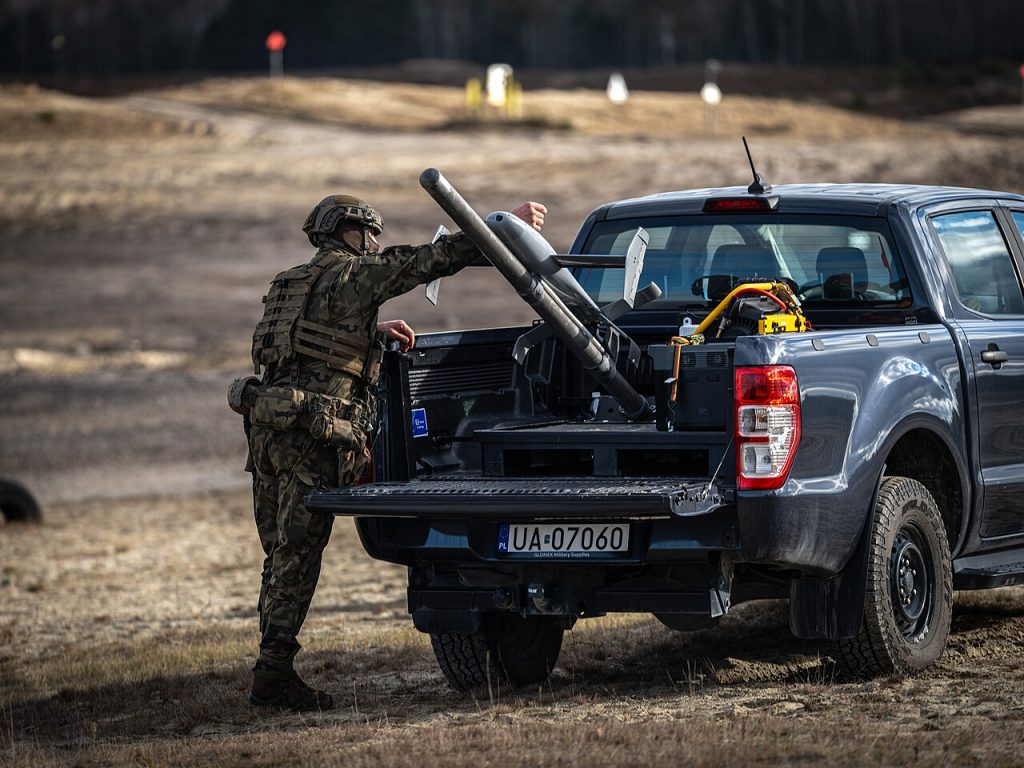
The system is remarkably portable. During recent live-fire demonstrations in Poland, soldiers launched the interceptors from the beds of standard pickup trucks. This mobility allows for a distributed defense network that can be rapidly repositioned to meet emerging threats, a stark contrast to the static nature of traditional air defense batteries.
Technical Edge: Autonomy and Lethality
What sets the Merops apart from a standard FPV drone is its degree of autonomy. While many tactical drones require a constant link to a pilot, the Merops is designed to find and engage its target with minimal human intervention once launched. This capability is vital in contested environments where electronic warfare and signal jamming are the norm. The system uses a suite of onboard sensors, including radio frequency tracking and thermal signatures, to home in on its prey.
Structurally, the Merops is a fixed-wing platform capable of reaching speeds up to 280 kilometers per hour. It carries a two-kilogram fragmentation warhead, enough to ensure the complete destruction of most Group 1 and Group 2 unmanned aerial systems. Its range of up to 20 kilometers gives it a significant engagement envelope, allowing it to intercept threats well before they reach their intended targets.
The Impact of Silicon Valley Innovation
There is a distinct Silicon Valley fingerprint on this technology. Perennial Autonomy, the company behind the Merops, was founded with backing from former Google CEO Eric Schmidt. The influence is evident in the system’s focus on software-defined capabilities and iterative development. By recruiting engineers from firms like Apple and SpaceX, the company has managed to build a weapon system that behaves more like a modern tech product than a traditional defense contract deliverable.
This “commercial first” approach to defense hardware is becoming the new standard. It emphasizes speed to market and ease of use, ensuring that soldiers on the ground can operate the system with minimal training. The success of the Merops suggests that the future of the American defense industry may reside as much in California and Austin as it does in the traditional hubs of the Beltway.
Looking Ahead: The New Air Defense Reality
The deployment of the Merops marks a turning point. It is an acknowledgment that the age of the “drone swarm” is here and that traditional defenses are insufficient to meet the volume of the threat. As these systems continue to roll out to units in the Middle East and Europe, they will provide a critical test case for how modern militaries can adapt to the shifting realities of the 21st-century battlefield.
For the drone industry at large, the Merops represents the high-water mark for autonomous interceptor technology. It proves that autonomy, lethality, and affordability can coexist in a single platform. As this technology matures, the lessons learned from its deployment will undoubtedly trickle down into the commercial and industrial drone sectors, further accelerating the development of smarter, more resilient autonomous flight systems.
The Army’s bet on the Merops is a calculated one. They are betting that they can out-produce and out-innovate a decentralized threat by leveraging the best of private sector ingenuity. If current performance metrics hold, it is a bet that is very likely to pay off.