
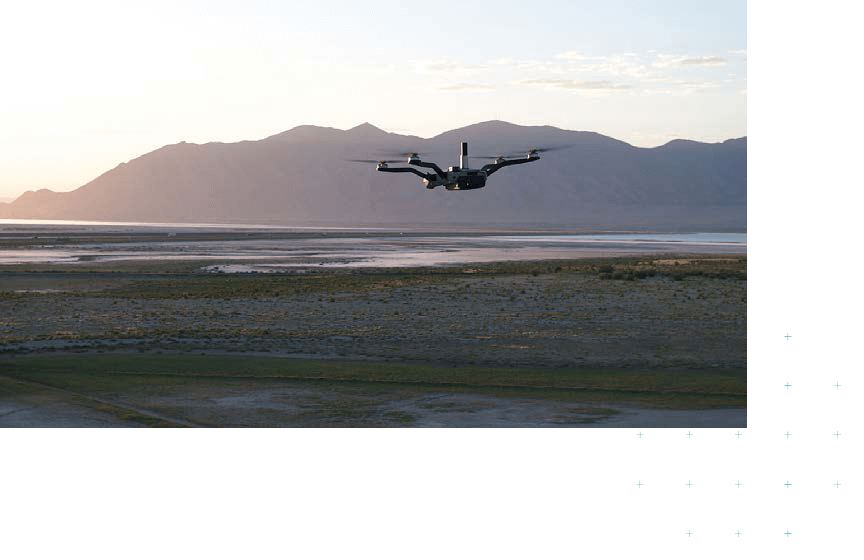
The gap between a boots-on-the-ground drone operator and a fighter pilot traveling at Mach 1.6 has historically been a chasm of radio static and verbal coordinate relays. While a platoon leader might see a clear high-resolution thermal feed of an enemy position on their tablet, the pilot overhead often relies on a verbal “talk-on” to find the same target. That dynamic is shifting. The U.S. Air Force has issued a notice for Teal Drones’ Black Widow, a small unmanned aerial system (sUAS) designed to bridge this divide by feeding live targeting data directly into the cockpit of the F-35 Lightning II.
This development is part of a broader push toward manned-unmanned teaming (MUM-T). It represents a move away from drones as isolated sensors and toward an integrated network where the F-35 acts as the “digital quarterback.” By utilizing the Black Widow as a forward-deployed sensing node, the Air Force aims to increase the lethality of its premiere stealth fighter while keeping it outside the reach of short-range air defenses.
The Architecture of Integration
The Black Widow is not just another quadcopter. Manufactured in the United States by Teal Drones, a subsidiary of Red Cat Holdings, it was built specifically for short-range reconnaissance (SRR) within the Department of Defense framework. Its technical foundation is built on the Qualcomm RB5 chip, providing the processing power necessary for edge-based artificial intelligence and complex data handling.
In the context of the F-35 integration, the Black Widow serves as a remote “eye” that can operate in environments too dangerous or too cluttered for a manned jet. The system uses a Doodle Hex-Band Radio with frequency-stepping capabilities, which provides resilience against electronic warfare and jamming. This ensures that the data link between the drone and the aircraft remains stable even in contested environments.
The key to this link is the ability to stream real-time targeting data. Unlike traditional systems where data must be routed through a ground station and then back up to the aircraft, the goal here is a more direct path. By providing a live video feed and precise coordinates directly to the F-35’s glass cockpit, the Black Widow allows the pilot to “see” what the drone sees through their Distributed Aperture System (DAS) or Helmet Mounted Display System (HMDS).
Sensors and Capability
To be an effective targeting lead, a drone needs more than just a camera; it needs a sensor suite that can distinguish friend from foe in varying conditions. The Black Widow utilizes the Teledyne FLIR Hadron 640R+ payload, which combines a high-resolution 64-megapixel visual sensor with a Boson+ radiometric thermal camera.
The 64-megapixel sensor provides the clarity needed for long-range identification during daylight. However, the Boson+ thermal sensor is perhaps the more critical component for modern warfare. With a resolution of 640×512 and thermal sensitivity of less than 30 mK, it can detect heat signatures with enough precision to identify specific vehicle types or hidden personnel through foliage.
When these sensors are combined with the Integrated FLIR Prism AI software stack, the drone can automatically identify, track, and classify targets. This reduces the cognitive load on the operator (or the pilot monitoring the feed). Instead of staring at a screen trying to find a target, the AI highlights potential threats, allowing the human in the loop to make the final engagement decision.
Comparing the Contenders: Black Widow vs. Skydio X10D
Teal is not the only player in this space. The U.S. Army recently placed a $52 million order for 2,500 Skydio X10D drones, another American-made powerhouse. Understanding the nuance between these two systems is vital for understanding the current state of tactical sUAS.
| Feature | Teal Black Widow | Skydio X10D |
|---|---|---|
| Weight | 4.26 lbs | 4.7 lbs |
| Flight Time | 45+ Minutes | 40 Minutes |
| Radio | Hex-Band (EW Resilient) | Multi-Band (EW Resilient) |
| Autonomy | Prism AI / Visual Nav | Skydio Autonomy (360 Avoidance) |
| Thermal Sensor | FLIR Boson+ (640×512) | FLIR Boson+ (640×512) |
| Visual Sensor | 64 MP | Up to 64 MP (Configurable) |
The Skydio X10D is widely praised for its near-total autonomy. Its obstacle avoidance system is arguably the best in the industry, allowing it to fly through dense forests or inside buildings with minimal pilot input. The Black Widow, while possessing forward-looking obstacle avoidance and visual navigation for GPS-denied environments, leans more heavily into its role as a modular, field-repairable reconnaissance asset with a focus on electronic warfare resilience.
The Air Force’s interest in the Black Widow likely stems from this modular architecture. It allows for swift adaptation to specific mission requirements, such as the specialized data link needed for F-35 coordination. While the X10D is a phenomenal “scout,” the Black Widow is being positioned as a specialized “link” in the kill chain.
Tactical Implications: The Kill Chain
Integrating a small drone with a stealth fighter changes the geometry of the battlefield. In a standard strike mission, an F-35 might have to fly closer to a target than is ideal to identify it using its own onboard sensors, such as the Electro-Optical Targeting System (EOTS). While the F-35 is stealthy, every mile closer to an integrated air defense system (IADS) increases risk.
By using the Black Widow, the F-35 can remain at a safer distance or a higher altitude. The drone, which has a tiny visual and radar cross-section, can loiter near the target area. Once the drone identifies a target, it passes the data to the F-35. The pilot can then launch a precision-guided munition, such as an SDB II (Small Diameter Bomb), from a standoff range.
This setup also facilitates “non-kinetic” effects. A Black Widow can be used to perform battle damage assessment (BDA) immediately after a strike, something that is difficult to do with a fast-moving jet. The pilot can see instantly if the target was destroyed or if a second pass is required, all without having to circle back over a dangerous area.
The Challenges of Connectivity
While the vision of a connected battlefield is compelling, the execution is difficult. The primary hurdle is latency. For a pilot to use a drone’s data for targeting, that data must be near-instantaneous. A delay of even a few seconds could mean the difference between a successful hit and a wasted munition on a moving target.
Security is another major concern. A data link that connects a $130 million fighter jet to a $15,000 drone is a potential vulnerability. If an adversary can jam that link, the system fails. Even worse, if they can spoof the data, they could potentially feed false coordinates to the pilot. This is why the use of AES-256 encryption and frequency-stepping radios like the Doodle Hex-Band is not just a feature, but a requirement for the Black Widow.
Survival and Field Repair
In a conflict with a near-peer adversary, equipment will get broken. One of the standout features of the Black Widow is its “Arachnid” family heritage, which emphasizes modularity. The arms and payloads of the drone can be swapped in the field without specialized tools.
This is a departure from the “disposable” drone philosophy seen in some theaters. While loitering munitions (suicide drones) are effective, a reconnaissance asset that can be repaired and returned to the air within minutes provides more sustained value to a unit. It also allows for the payload to be upgraded as sensor technology improves, ensuring the airframe doesn’t become obsolete within a few years.
The Path Forward
The Air Force notice for the Black Widow is a signal that the era of isolated platforms is ending. We are moving toward an ecosystem of systems where information is the most valuable commodity. The F-35 is no longer just a fighter; it is a node in a honeycomb of sensors and effectors.
The integration of the Black Widow represents a pragmatic step. It uses a proven, American-made sUAS to solve a specific problem: bridging the gap between the ground-level view and the high-altitude cockpit. As the software matures and the data links become even more robust, the “digital quarterback” will find itself with an increasingly capable team of robotic wingmen.
For drone operators and aviation enthusiasts, the message is clear. The distinction between “small drones” and “big aviation” is blurring. The future of flight is a shared one, where the smallest rotorcraft and the most advanced stealth jets speak the same digital language.