
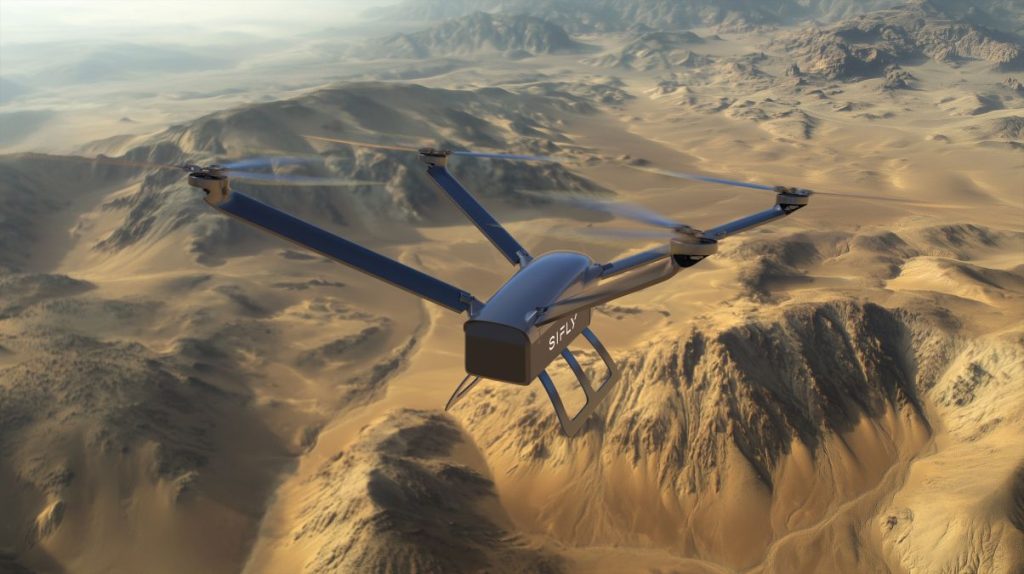
Multirotors are aerodynamic compromises. They sacrifice horizontal aerodynamic efficiency in exchange for mechanical simplicity, precision hover, and omnidirectional agility. For over a decade, enterprise drone operations have accepted the operational tax: 35 to 45 minutes of nominal flight time, plummeting to under 25 minutes once operators bolt on a dual optical and radiometric thermal payload. SiFly Aviation is betting $20 million that this endurance ceiling was an engineering deficiency rather than an unyielding physical constraint.
Capital Allocation and Hardware Discipline
California-based SiFly Aviation closed a $20 million Series A round led by Shield Capital, with participation from Qudit, BBK Capital, Alumni Ventures, and strategic angel investors. The backing is revealing. Shield Capital specializes in national security and critical infrastructure resilience, sectors where procurement officers have grown weary of software platforms running on fragile, re-badged commercial hardware.
SiFly is led by CEO Brian Hinman, whose previous operational track record includes co-founding PictureTel, Polycom, and 2Wire. Hinman brings mature telecommunications and enterprise hardware manufacturing discipline to an uncrewed aviation sector often dominated by venture-backed software startups that outsource core manufacturing to third parties. The capital injection is allocated directly toward scaling domestic manufacturing capacity, hardening domestic supply chains, and ramping serial deliveries against an expanding customer backlog.
The Q12 Architecture: Breaking the 3-Hour Benchmark
The centerpiece of SiFly’s portfolio is the Q12, an electric multirotor designed to bridge the operational divide between agile quadcopters and long-range fixed-wing platforms. Historically, operators facing wide-area inspection or persistent overwatch requirements had to deploy fixed-wing or transition VTOL platforms. While aerodynamically efficient in forward cruise, fixed-wing aircraft cannot maintain a static hover, require expansive clear zones for launch and recovery, and struggle in tight urban canyons or complex structural environments.
SiFly claims the Q12 delivers four to five times the loiter duration and up to ten times the operational radius of conventional enterprise quadcopters while carrying payloads up to 10 pounds (4.5 kilograms). Unlike typical promotional claims in the drone ecosystem, SiFly validated its propulsion and energy management architecture under formal third-party observation, establishing an official Guinness World Record with a continuous flight duration of 3 hours, 11 minutes, and 54 seconds for an electric multirotor in its weight category.
Achieving this level of endurance on pure battery-electric architecture requires systemic optimization across three distinct disciplines:
- Low Disc Loading Aerodynamics: Utilizing oversized, high-efficiency carbon fiber prop blades operating at lower RPMs, reducing induced drag and increasing the lift-per-watt figure of merit.
- Custom Powertrain Tuning: High-efficiency brushless motors with custom stator and magnet configurations matched to the specific cruise and hover voltage curves of the power system.
- Integrated Thermal Management: High-density lithium battery modules paired with active thermal dissipation, preventing thermal runaway and mitigating voltage sag during prolonged power draws.
Drone-as-First-Responder and Linear Infrastructure Economics
Extending airframe endurance fundamentally alters the unit economics of autonomous uncrewed operations. In modern Drone-as-First-Responder (DFR) programs and utility inspection pipelines, the primary operational bottleneck is not cruise velocity: it is the asset replenishment cycle. Standard 30-minute flight limits force operators to deploy dense networks of automated docking stations to maintain continuous situational overwatch.
SiFly is pairing the Q12 with its proprietary DronePort automated nesting station. A multirotor capable of loitering over an active public safety incident or wildland fire perimeter for 90 to 120 minutes with a full sensor payload reduces the required dock density and airframe count per square mile by more than 50 percent. For electric utilities monitoring high-voltage transmission lines or energy companies surveying pipeline rights-of-way, tripling continuous flight duration eliminates the costly crew repositioning and constant battery cycling that drive up per-mile inspection costs.
Domestic Production in a Decoupling Market
The timing of SiFly’s production expansion intersects with structural shifts in federal trade and procurement policy. Following recent 100% tariffs on imported drone platforms and strict National Defense Authorization Act (NDAA) supply-chain compliance mandates, commercial operators and municipal public safety agencies face a constrained supply of viable enterprise platforms.
Shield Capital partner Ray Rothrock noted that endurance translates directly into lower mission overhead and higher operational tempo. If SiFly can manufacture and deliver the Q12 at scale from its California facilities without running into the supply bottlenecks that have slowed other domestic UAV producers, it stands to capture substantial market share in an enterprise drone ecosystem eager for authentic endurance gains.