
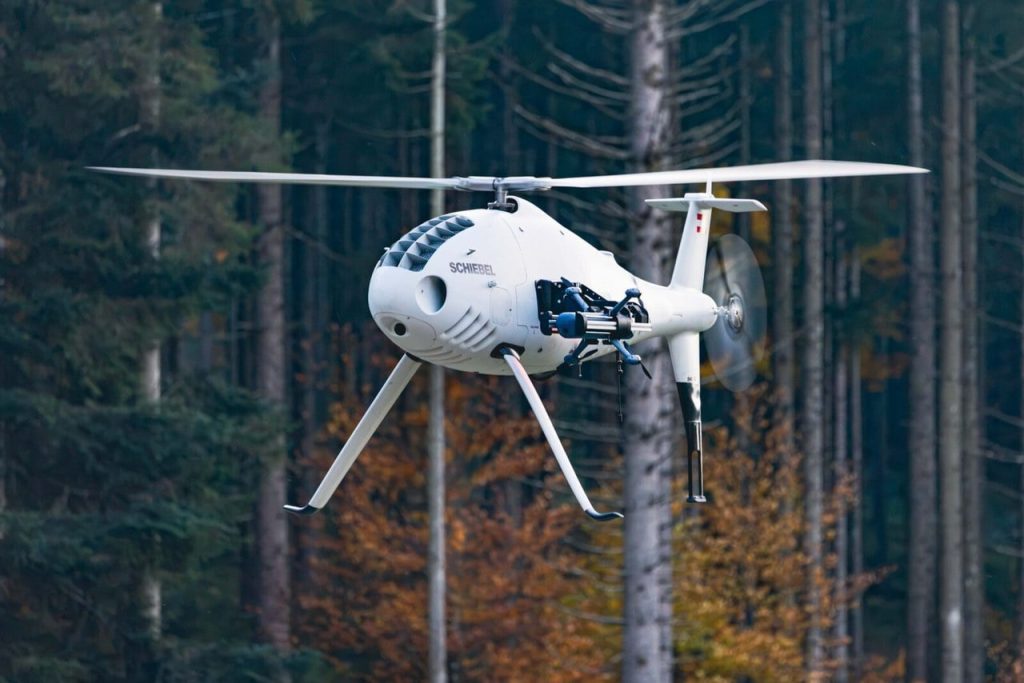
Austrian unmanned aviation manufacturer Schiebel, in partnership with Polish defense technology developer OSIRIS Poland, has validated an airborne mothership concept using its rotary-wing CAMCOPTER S-100 unmanned aerial system. During flight trials in Austria, the S-100 carried, air-launched, and maintained continuous command and control over a secondary high-speed drone in forward flight.
Airborne Deployment Architecture
The demonstration integrated an inert variant of the OSIRIS HSCD-1 (High-Speed Camera Drone) onto an external side payload hardpoint of the CAMCOPTER S-100. During forward cruising flight, the host helicopter released the smaller aircraft, which transitioned autonomously into powered flight.
Following separation, the S-100 functioned as an airborne radio frequency relay station. Operators on the ground controlled the HSCD-1 and received live payload telemetry and video feeds through data links routed directly through the orbiting S-100, rather than maintaining a direct ground-to-sub-drone line of sight.
Technical Specifications and Payload Mechanics
The CAMCOPTER S-100 is a mature, shipboard-qualified rotary UAS with a maximum takeoff weight of 200 kilograms and a payload capacity of up to 50 kilograms. Key performance parameters relevant to the carrier role include:
- Flight Endurance: Up to 10 hours with standard fuel configuration, providing extended loiter windows over operational sectors.
- Operational Speed: Cruise speed of 55 knots with a maximum dash capability of 120 knots.
- Data Link Architecture: Encrypted line-of-sight communications range up to 200 kilometers (108 nautical miles), with optional satellite communications integration for beyond line of sight operations.
- Payload Distribution: Dedicated hardpoints including nose, side, and internal main bays, enabling simultaneous carriage of sub-launched aircraft and primary electro-optical/infrared reconnaissance gimbals.
Overcoming Tactical Drone Range and RF Constraints
Small, high-speed unmanned aircraft provide rapid target acquisition and kinetic interception capabilities, but they operate under strict physical constraints. Compact airframes have limited battery capacity, restricting flight endurance to minutes. Furthermore, low-altitude flight profiles degrade ground-based radio links due to terrain masking, foliage attenuation, and Earth curvature.
Utilizing a medium-altitude rotary platform as an airborne launch point resolves both bottlenecks. The S-100 transports the interceptor across transit corridors without depleting the smaller airframe’s onboard energy reserves. Once deployed, the host platform’s elevated operating altitude maintains uninterrupted line-of-sight communication, extending the effective operational radius of the sub-drone system.
Counter-UAS and Force Multiplier Applications
Schiebel stated that the proof of concept establishes a baseline for dedicated Counter-Unmanned Air System (C-UAS) mission profiles. While the Austrian test utilized an inert camera drone, the carrier architecture is designed to support active interceptor drones equipped with specialized effectors, electronic warfare packages, or loitering munitions.
The company plans to extend the deployment architecture across its broader platform portfolio, including the heavier CAMCOPTER S-300 system as well as the S-101 and S-301 variants. By combining endurance-class carrier drones with agile interceptors, naval vessels and forward operating bases can project targeted counter-drone defenses across contested airspace without deploying crewed aircraft.