
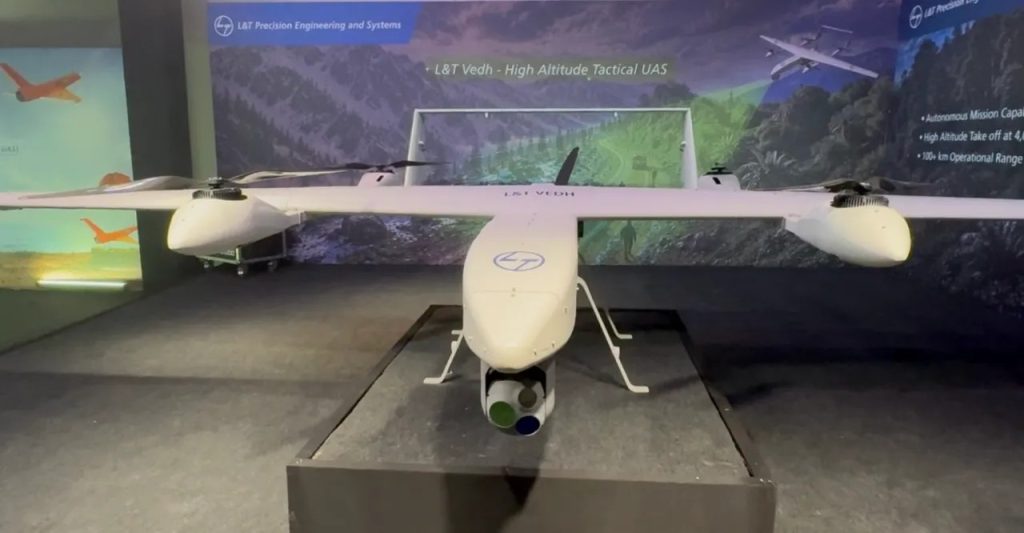
Larsen & Toubro used its Manthan Drone Demo Day event in Bengaluru on August 7, 2026, to unveil two pieces of hardware and software that say more about where the drone industry is headed than any single product launch has in months.
The first is Vedh Mk1, a high altitude, runway independent remotely piloted aircraft system built for long endurance surveillance missions. The second, Chanakya, is not an aircraft at all. It is a collaborative mission autonomy framework designed to let different classes of uncrewed systems operate as a coordinated group rather than as isolated remote controlled platforms.
The industry’s real bottleneck was never the airframe
For most of the commercial drone market’s short history, competitive advantage came from the aircraft itself: endurance, payload capacity, range, and cost per unit. L&T’s announcement suggests that era is closing. Arun T. Ramchandani, Senior Vice President and Head of Precision Engineering and Systems at L&T, framed the shift bluntly: the next era of aviation gets defined by how intelligently a system perceives its surroundings, how fast it decides, how well it collaborates with other machines, and how reliably it finishes a mission when navigation, communications, and human oversight are degraded or absent.
That is a fundamentally different design brief than “fly further, carry more.” It pushes complexity off the airframe and onto the software and sensor stack, which is exactly where Chanakya is meant to live.
Why collaborative autonomy is the harder problem
A single autonomous aircraft has to handle its own navigation, sensor fusion, decision making, and secure communication without constant human input. That is already a nontrivial engineering problem. Chanakya targets something harder: getting multiple autonomous platforms, potentially of different types and roles, to understand not just their own tasks but what every other asset in the mission is doing and how the plan should adjust as conditions change.
This is the same problem that has occupied Western defense primes and startups chasing “swarm” and “manned unmanned teaming” concepts for years, usually with limited public detail about how far the software has actually progressed. L&T putting a named framework in front of press at a public event, rather than keeping it entirely behind classified contract walls, is itself notable. It signals confidence that the technology has moved past slideware.
What this means for the broader market
India’s drone sector has spent the past few years building indigenous manufacturing capacity, largely in response to defense procurement rules favoring domestic suppliers. Vedh Mk1 and Chanakya suggest that capacity is now being paired with software ambitions that go beyond import substitution. A runway independent, high altitude RPAS plus a collaborative autonomy layer is a combination aimed squarely at long duration ISR and tactical missions, the same segment where US and European players like General Atomics and Airbus have been consolidating contracts.
Whether Chanakya scales beyond demo day remains the open question. Autonomy frameworks tend to look impressive in controlled showcases and get considerably messier once they meet contested electromagnetic environments and real mission tempo. L&T has put a stake in the ground. The next test is whether it holds up outside Bengaluru.