
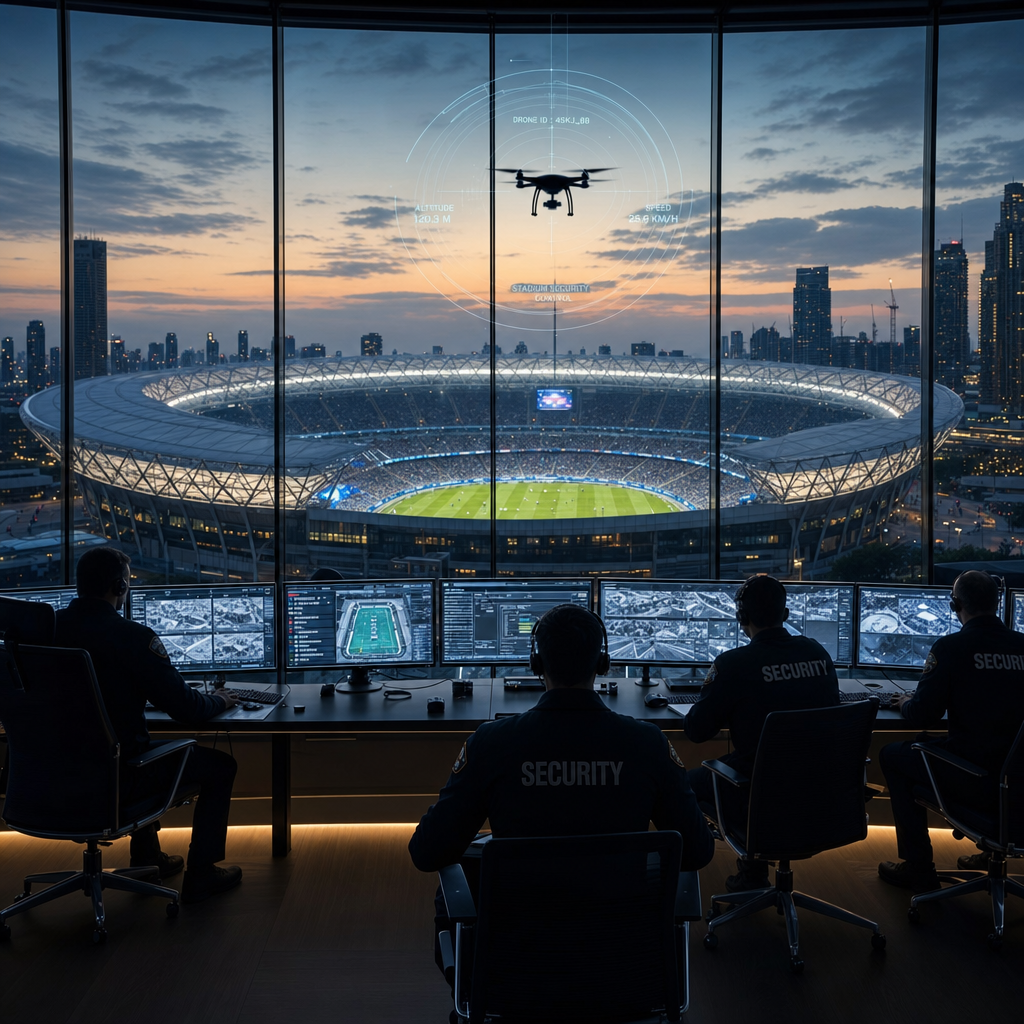
The FIFA World Cup 2026 is set to be the largest sporting event in history, spanning three nations and dozens of cities. But as fans prepare for the spectacle, security agencies are bracing for a logistical nightmare that moves at 60 miles per hour and fits inside a backpack. According to recent reports, the FBI is finalising plans to deploy a highly specialised counter-drone force across all 11 US host cities to combat the growing threat of unauthorized sUAS (small Unmanned Aircraft Systems).
The New Air Marshal
Security for major events has historically focused on what happens on the ground. However, the proliferation of consumer drones like the DJI Mavic series and high-speed FPV (First Person View) quads has forced a vertical shift in strategy. The FBI plans to field approximately 60 specially trained state and local police officers, operating under federal guidance, to monitor the airspace around stadiums. This team is not just there to watch. They are equipped with technology capable of detecting, identifying, and, most importantly, disabling drones that venture into restricted airspace.
The threat is twofold. First, there is the risk of accidental interference or kinetic collisions with crowds. A three-pound drone falling from a few hundred feet is a lethal projectile. Second, and more concerning to federal agencies, is the potential for drones to be used as delivery systems for hostile payloads. We have seen the evolution of drone warfare in Eastern Europe over the last four years. The jump from hobbyist toys to tactical tools is now a matter of software, not just hardware.
Beyond Jamming: The Art of the Hijack
For years, the standard response to a rogue drone was signal jamming. By flooding the frequency (usually 2.4GHz or 5.8GHz) with noise, a jammer severs the link between the pilot and the aircraft. This usually triggers a “Return to Home” (RTH) sequence or forces the drone to land where it stands. However, jamming is a blunt instrument. In a dense urban environment like a World Cup host city, high-powered RF jamming can interfere with emergency services, Wi-Fi networks, and cellular communications.
The 2026 strategy relies on more sophisticated methods. Advanced systems, such as those developed by firms like Sentrycs, allow security forces to “talk” to the drone in its own language. Rather than screaming over the pilot, these systems can impersonate the command signals. The result is a clean takeover. The FBI can effectively hijack the drone, taking control of its flight path and directing it to a safe, designated landing zone outside the stadium perimeter. This method prevents the drone from falling onto spectators and allows law enforcement to preserve the aircraft for forensic analysis.
The Enforcement Gap
While the technology is impressive, the scale is the challenge. The World Cup covers a massive geographic area. Sixty officers across 11 cities is a lean operation. This suggests the FBI is relying heavily on automated detection clusters. These sensors monitor the Radio Frequency (RF) spectrum for signatures unique to common drone brands. When a signature is detected, the system geolocates both the drone and the pilot, often before the aircraft even reaches the stadium grounds.
For the average drone pilot, the message is clear: the FAA-designated No Fly Zones (NFZs) during the World Cup will be strictly enforced with a zero-tolerance policy. This is not just about a fine or a slap on the wrist. If you fly near a stadium during the games, your drone might not come back. It will be seized through electronic means, and local law enforcement will likely be at your launch point before your props have stopped spinning.
The Future of Public Security
This deployment represents a shift in domestic airspace control. What we are seeing at the 2026 World Cup is a preview of the “smart city” security infrastructure of the 2030s. As package delivery drones and eVTOL (electric Vertical Take-Off and Landing) air taxis become common, the ability to selectively hijack or disable unauthorized aircraft becomes a requirement for public safety. It is an end to the era of unrestricted hobbyist flight in metropolitan areas, but it is the price of keeping the world’s biggest game safe.
If you are planning to travel to the US for the tournament, leave the drone at home. The FBI is ready to take the controller out of your hands.
Stay tuned to aerial.io for more updates on drone regulations and the latest in aviation technology. We will be tracking the 2026 security rollout as more details on the specific hardware being used become available.