
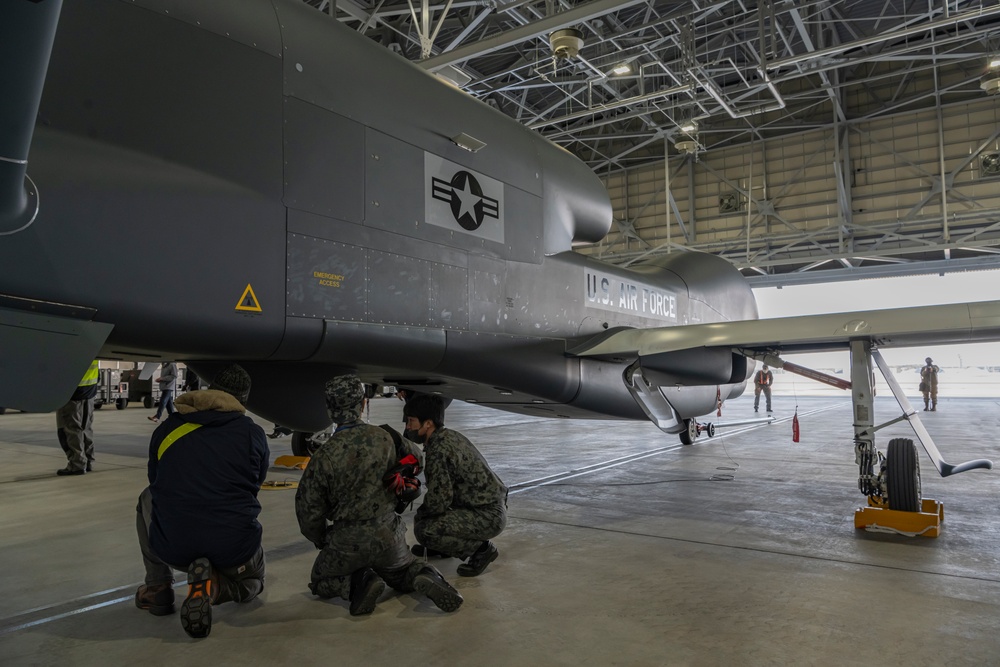
The Japan Air Self-Defense Force (JASDF) has confirmed the loss of an RQ-4B Global Hawk Block 30(I) high-altitude, long-endurance (HALE) unmanned aerial vehicle following a crash in the Sea of Japan off the coast of Tottori Prefecture. The incident, which occurred during an active operational flight on September 15, reduces Japan’s strategic high-altitude surveillance inventory from three airframes to two.
Timeline of the Incursion and Disconnect
According to the JASDF and the Ministry of Defense, the RQ-4B departed Misawa Air Base in northern Aomori Prefecture at 10:20 a.m. local time on an operational surveillance tasking. Ground control teams maintained nominal tracking until 12:55 p.m., when primary and secondary satellite datalinks failed simultaneously. Radar contact with the airframe ceased three minutes later at 12:58 p.m. over international waters, approximately 50 kilometers off the Tottori coastline.
A search and rescue helicopter from the Japan Coast Guard located floating wreckage 50 minutes after signal loss. Subsequent maritime sweeps by Self-Defense Force aircraft and surface vessels photographed floating debris confirming structural breakup and surface impact. JASDF Chief of Staff General Takehiro Morita confirmed the loss in a briefing, stating that the mission was an active operational sortie rather than a training flight.
Fleet Fragility in Micro-Fleet Operations
The crash underscores the mathematical fragility of operating micro-fleets of tier-one strategic assets. Japan purchased three RQ-4B Global Hawks via the U.S. Foreign Military Sales (FMS) program to maintain persistent wide-area surveillance over the Sea of Japan and the East China Sea. All three airframes were assigned to the JASDF 502nd Squadron at Misawa Air Base, operating alongside U.S. Pacific Air Forces detachments.
In high-altitude long-endurance architectures, a three-aircraft rotation represents the bare minimum necessary to sustain a single continuous orbit: one aircraft on station, one in transit or hot standby, and one undergoing scheduled heavy depot maintenance. The loss of a single airframe reduces operational availability below the threshold required for unbroken 24/7 coverage, forcing operational planners to accept coverage gaps or accelerate airframe fatigue on the surviving two units.
Logistical and Supply Chain Realities
Replacing the lost airframe will not be quick or cheap. The RQ-4B Block 30 production lines have transitioned, with unit flyaway costs previously exceeding $130 million before mission sensor suites and ground control segments are factored in. Any procurement request to replace the lost airframe must navigate Foreign Military Sales authorizations, long-lead component manufacturing, and software configuration matching Japan’s specific secure communication links.
The Ministry of Defense has established an accident investigation board to review telemetry logs, ground station command queues, and weather data. While formal training sorties have been suspended across the 502nd Squadron pending preliminary findings, operational theater monitoring will now rely more heavily on manned assets and allied intelligence-sharing frameworks.