
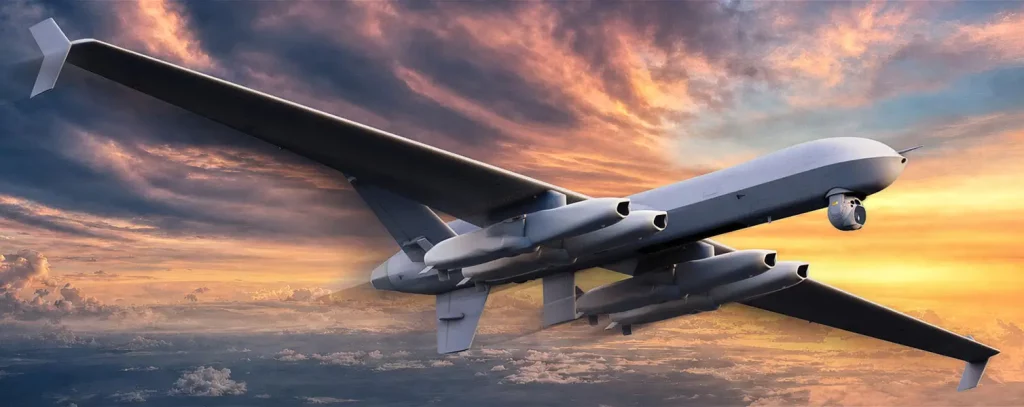
For nearly three decades, medium-altitude, long-endurance (MALE) uncrewed aviation followed a predictable trajectory: higher unit costs, longer development cycles, and increasingly exquisite sensor payloads. The MQ-9A Reaper and MQ-9B SkyGuardian proved indispensable in permissive environments, but modern contested air defense networks turned high-cost, single-digit production airframes into operational liabilities. General Atomics Aeronautical Systems (GA-ASI) has now responded with a clean-sheet platform designed specifically around attrition tolerance: the Wildfire UAS.
Addressing the Attrition Dilemma
The core proposition behind Wildfire is economic realism. As anti-access/area-denial (A2/AD) envelopes expand across the Indo-Pacific and Eastern Europe, deploying high-value reconnaissance assets creates unfavorable loss-exchange ratios. Wildfire trades exquisite multi-role perfection for focused mission execution, simplified manufacturing, and lower unit procurement costs.
GA-ASI designed the platform to compete directly within the U.S. Air Force Defense Innovation Unit (DIU) Massed Modular Aircraft (MMA) initiative. The MMA program seeks scalable, rapidly deployable alternatives to legacy MALE drones, prioritizing mass and payload over gold-plated survivability suites.
Specifications and Payload Architecture
Despite being optimized for lower manufacturing costs, the performance figures disclosed by GA-ASI exceed baseline DIU program requirements:
- Range and Endurance: Wildfire boasts a ferry range exceeding 8,000 nautical miles, providing the operational reach required for trans-Pacific maritime transit without extensive tanker support.
- Heavy Strike Capabilities: The airframe features strengthened hardpoints engineered to carry two Long-Range Anti-Ship Missiles (AGM-158C LRASM) simultaneously. Alternatively, it can carry up to four Joint Strike Missiles (JSM) or diverse combinations of launched effects (LEs) and electronic warfare pods.
- Modular Architecture: Mission payloads can be swapped at field-level echelons, enabling quick conversions between maritime strike, stand-in ISR, electronic attack, and heavy-cargo logistics.
Autonomy and Networked Fleet Control
Hardware mass is useless without resilient command links. Wildfire directly integrates the collaborative autonomy stack developed for GA-ASI’s FQ-42A Collaborative Combat Aircraft (CCA). Rather than requiring dedicated pilot stations for each aircraft, the system is architected for collaborative operations where a single operator or distributed network supervises multiple airframes.
Communication relies on proliferated Low Earth Orbit (pLEO) satellite constellations. This approach mitigates the latency and single-point-of-failure vulnerabilities typical of geostationary SATCOM relays, giving formations resilient command link redundancy under contested electronic warfare conditions.
Industrial Scalability and Timelines
DIU target timelines project operational deployments for the MMA initiative by FY2031. GA-ASI claims it can deliver operational Wildfire systems years ahead of that target. The company is leveraging its established supplier network and existing composite fabrication tooling, aiming to produce the aircraft at more than twice the volume rate of traditional defense aerospace programs.
If GA-ASI executes on its delivery targets, Wildfire will represent an important tactical shift in military uncrewed aviation: moving from scarce, irreplaceable assets to distributed, massed combat systems capable of taking kinetic risk.