
The Paradigm Shift in Counter-Drone Warfare
For years, the promise of laser-based defense systems has been just that — a promise. We have seen massive, truck-mounted continuous-wave lasers that require a dedicated power plant and cost more than the assets they are meant to protect. They were scientific curiosities, not tactical tools. That changed this week with the unveiling of the Esh-Tech DroneLight.
Esh-Tech is not just building another laser. They are attempting to rewrite the physics of tactical engagement. By moving away from continuous-wave (CW) architectures to a high-intensity pulsed laser, they have managed to solve the two biggest hurdles in modern C-UAS (Counter-Unmanned Aircraft Systems): power consumption and kill time.
Pulsed vs. Continuous: Why It Matters
To understand why DroneLight is significant, you have to understand the inefficiency of current systems. Standard CW lasers work by heating a target until it melts or ignites. It is a slow process, often requiring 15 seconds or more of constant tracking on a single point. In a swarm scenario, that 15-second dwell time is an eternity. It is the difference between neutralizing a threat and being overwhelmed by it.
DroneLight uses a breakthrough pulsed architecture. Instead of a steady beam, it delivers short, concentrated bursts of energy. Think of it as a jackhammer versus a blowtorch. Each pulse physically removes material through a drilling effect. This allows the system to achieve a hard-kill in 1 to 2 seconds. When you can drop a drone every two seconds, you are no longer just defending against single threats; you are effectively countering swarms.
The Mobility Advantage
Mobility has always been the Achilles heel of directed energy weapons. If you need 20 kW of power to melt a plastic drone, you need a massive generator. That limits your defense to stationary strategic sites or heavy, slow-moving convoys. Esh-Tech’s system draws just 4 kW. That is a manageable load for standard military vehicle alternators.
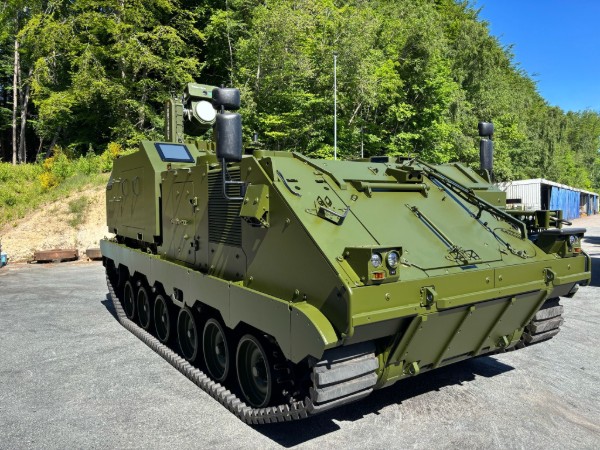
This low energy requirement means the DroneLight can be integrated into the tactical edge. It can sit on the roof of a standard patrol vehicle or a light armored transport. It brings hard-kill capabilities to the individual unit level, providing 360-degree coverage for maneuvering forces who previously had to rely on electronic warfare (EW) jamming or kinetic fire.
Beyond Jamming: The Necessity of the Hard-Kill
Electronic warfare has been the primary defense against drones for the last decade. However, we are seeing a rapid evolution in drone autonomy. Modern FPVs (First Person View) and loitering munitions are increasingly being equipped with optical terminal guidance and frequency-hopping radios that make jamming inconsistent or entirely useless. Once a drone loses its link but continues its mission via pre-programmed GPS or visual inertial odometry, jamming is nothing more than noise.
The battlefield now requires a hard-kill solution. You need to physically destroy the airframe or the optics. Kinetic solutions (bullets and nets) have range and accuracy limitations. That is where DroneLight fits into the 1-km defensive layer. It is a precise, surgical tool that operates at the speed of light, making it nearly impossible for a drone to outmaneuver the beam once the automatic tracking system has a lock.
The Economics of Defense
Perhaps the most disruptive aspect of Esh-Tech’s announcement is the price point. The company claims the DroneLight will cost approximately 25% of legacy CW laser systems. In the world of defense procurement, that is a seismic shift. If you can buy four units for the price of one, you take directed energy out of the realm of elite specialized units and put it into the hands of the general force.
We are entering an era where the cost per interception must be lower than the cost of the threat. Using a $100,000 missile to down a $500 drone is a losing game of attrition. A laser interception costs only as much as the fuel used to generate the electricity. DroneLight represents the first time this economic reality has been packaged into a mobile, tactical form factor.
The Urban Challenge
Fighting in urban environments adds layers of complexity that traditional weapons struggle to handle. Collateral risk from stray bullets or falling debris is a major concern for commanders. Directed energy offers a narrow field of view and no side lobes. The energy goes exactly where it is pointed and nowhere else. Because the dwell time is so short, the risk of the beam hitting something behind the target is significantly reduced.
Precision is not just a luxury; it is a requirement for modern urban centers. DroneLight’s ability to operate in these high-stakes environments without endangering the surrounding infrastructure or civilian population makes it a more viable option than traditional anti-air artillery for domestic and urban security.
Conclusion
The Esh-Tech DroneLight is more than just a new product; it is a signal that the counter-drone industry is finally maturing. By focusing on pulsed energy, lower power draws, and tactical mobility, Esh-Tech has addressed the specific lessons being learned in current conflicts. The ability to neutralize 30 drones per minute from the back of a moving vehicle is no longer a concept for a future war. It is a reality that is ready for the field today. Commanders who ignore this shift in the tactical landscape will find themselves vulnerable to the very swarms that this technology was built to destroy.