
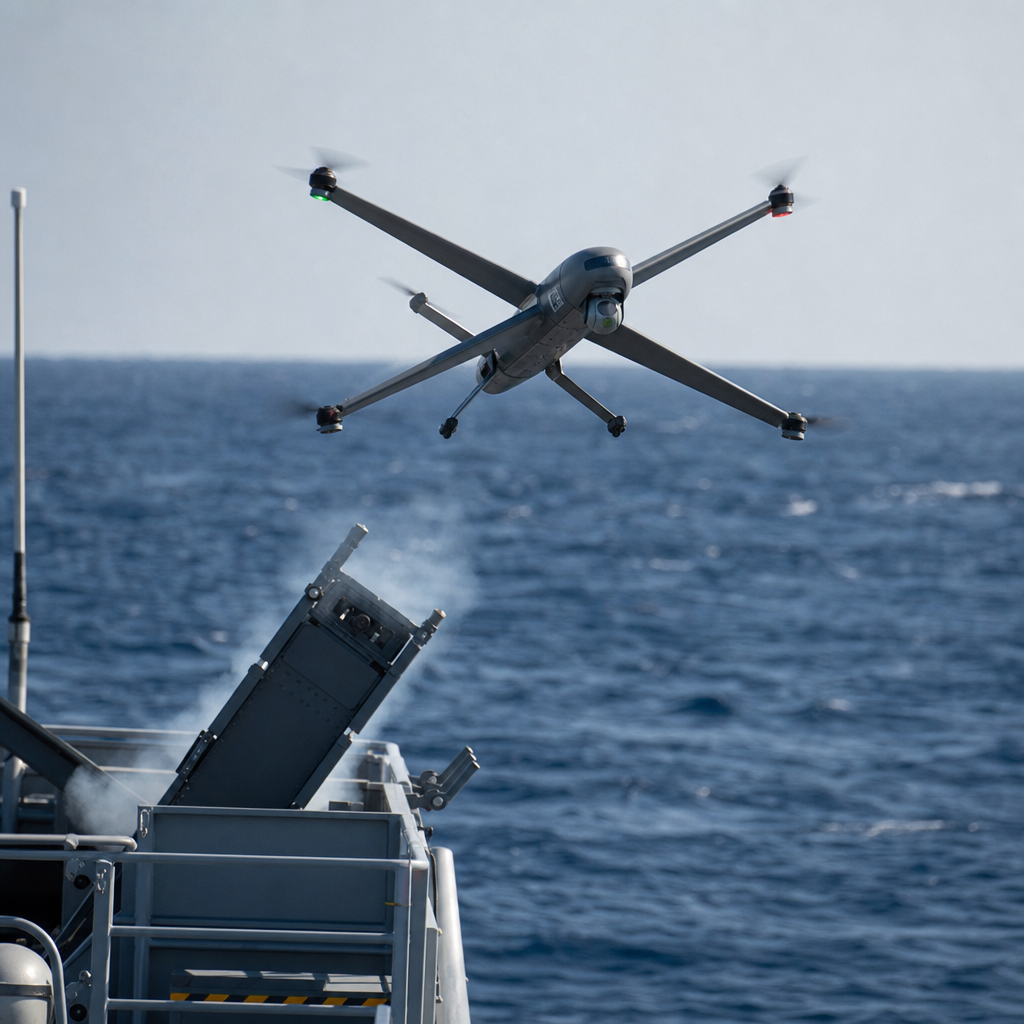
The concept of the “loitering munition” has existed for decades, but it took the brutal, high-attrition conflict in Eastern Europe to turn it from a niche capability into the primary metabolic process of modern warfare. As we move through May 2026, the tech is evolving faster than the procurement cycles of most major militaries. Leading this charge is Helsing, the European defense unicorn that just successfully demonstrated its HX-2 strike drone in a maritime environment off the coast of Plymouth, UK.
The Maritime Leap
Launching a drone from a stable land platform is relatively straightforward. Launching one from a small, bobbing naval vessel in the North Sea is a different beast entirely. The Plymouth trials proved that the HX-2 can handle the unique inertial challenges of sea-based deployment. For naval commanders, this is a game changer. It means that even a light patrol boat can now carry the punching power of a precision-guided missile at a fraction of the cost. This development is significant for littoral combat where larger vessels are often vulnerable to cheap, land-based anti-ship missiles.
The HX-2 is not just a drone; it is an AI-native strike system. Weighing in at 12 kilograms, it is light enough for a single operator to handle but carries enough explosive force to neutralize armored vehicles and artillery. With a range of 100 kilometers and a top speed of 220 km/h, it fills the gap between traditional FPV drones and expensive standoff missiles like the Switchblade 600 or the Hero-120. The airframe features a distinct X-wing configuration, which provides the agility needed for terminal guidance against moving targets like tanks or fast-moving boats.
AI at the Edge
What sets the HX-2 apart is its integration with Helsing’s software-first approach. Most drones rely on a constant, high-bandwidth link to a human operator. In a radio-frequency contested environment, which is the reality of any modern battlefield, that link is the first thing that breaks. The HX-2 is designed to operate in “denied” environments. It uses onboard computer vision to identify and lock onto targets autonomously once a human has authorized the engagement zone. This means the drone can continue its mission even if the pilot loses the signal due to jamming or terrain interference.
This “human-in-the-loop” but “AI-on-the-edge” architecture is the current gold standard for ethical and effective autonomous weapons. It reduces the cognitive load on the operator while ensuring the drone remains effective even when Russian or Chinese electronic warfare suites are screaming across the spectrum. The operator selects a target or a search area, and the drone handles the complex task of navigating and staying on target during the final moments of flight. This level of autonomy is no longer a luxury; it is a requirement for survival on the modern front line.
The Industrialization of Attrition
The Plymouth test is part of a broader European push for defense sovereignty. For too long, Europe relied on American systems that were either too expensive or too restricted for high-intensity use. Helsing, backed by significant private capital (including Spotify founder Daniel Ek), is building the HX-2 for mass production. This is about numbers. In a conflict where thousands of drones are lost weekly, you cannot rely on bespoke, handcrafted systems. You need a production line that can churn out thousands of units per month at a price point that makes sense for a single-use weapon.
The German Armed Forces, along with France and the UK, are already integrating these systems into their tactical planning. They are moving away from the “one big, expensive target” model towards a “swarm of cheap, intelligent threats” model. It is a fundamental shift in how we think about power projection. If a $20,000 drone can take out a $5,000,000 tank, the math of war changes forever. This is the industrialization of attrition, where the side that can produce the most intelligent “bullets” wins.
Tactical Flexibility and Deployment
The HX-2 is designed for rapid deployment. It can be launched from a catapult, a vehicle-mounted rack, or now, as proven in Plymouth, from a maritime platform. This versatility allows it to be integrated into various branches of the military. For the infantry, it provides organic long-range artillery support. For the navy, it offers a way to extend the sensor and strike range of small boat groups without the need for large aircraft carriers or expensive missile batteries. The system is also modular, allowing for different warheads depending on whether the target is a soft-skinned vehicle, an armored bunker, or a radar installation.
The recent maritime launch also highlights the drone’s ability to operate in salt-air environments, which are notoriously hard on electronics and propulsion systems. Helsing has clearly invested in the ruggedization of the HX-2, ensuring it can survive the rigors of naval operations. This is a critical factor for nations with long coastlines or those involved in protecting international shipping lanes from asymmetric threats.
Beyond the Frontlines
While the focus is currently on the HX-2’s military applications, the technology has implications for the commercial sector as well. The advancements in localized AI processing and inertial stability in maritime environments will eventually trickle down to high-end industrial drones used for offshore wind farm inspections and search and rescue operations. Imagine a search and rescue drone that can autonomously identify a person in the water in heavy seas without needing a high-speed data link to the shore. However, for now, the HX-2 remains a tool of war, reflecting the grim reality of 2026 geopolitics where the demand for kinetic solutions is at an all-time high.
The Verdict
The HX-2 represents the first real European rival to the dominant US and Israeli loitering munitions. It is faster than most of its competitors and its software stack is arguably more advanced. Its success in maritime trials shows that Helsing is not just looking at the land war in Ukraine, but also at the potential for conflict in the Indo-Pacific and the Mediterranean. For any military looking to modernize without breaking the bank, the HX-2 is currently the system to beat. It is a testament to what happens when you combine silicon valley-style software engineering with traditional defense manufacturing.