
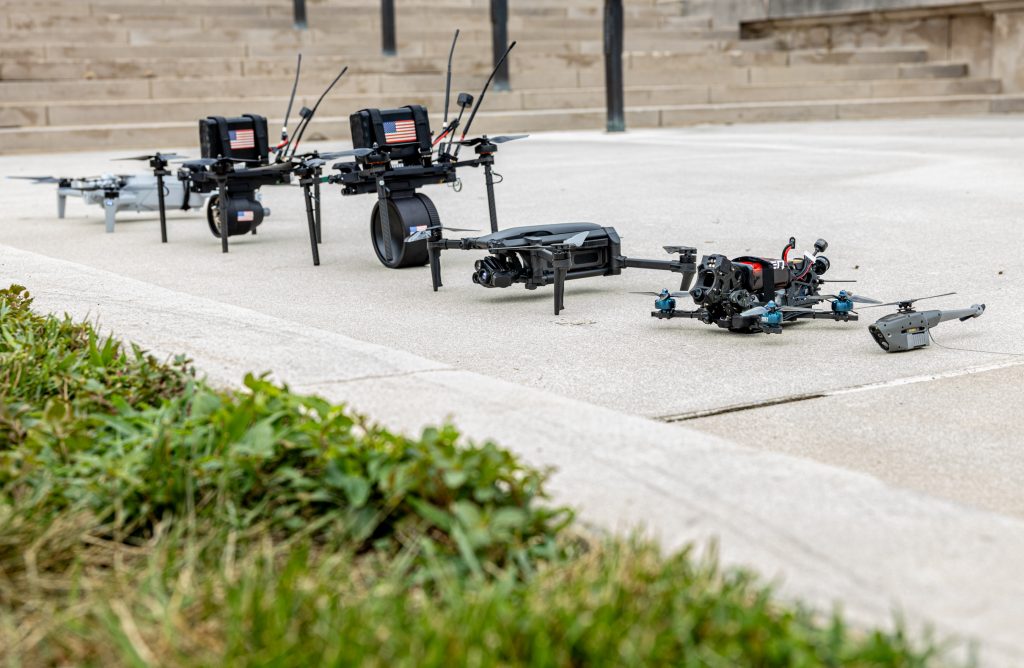
The Federal Communications Commission does not usually come up in conversations about drones. Spectrum allocation and device certification aren’t exactly cocktail topics. But what the FCC just did this week signals a shift that every drone manufacturer, operator, and policy watcher in the US should pay attention to.
On April 1, 2026, the FCC’s Wireless Telecommunications Bureau and Office of Engineering and Technology issued a public notice with a clear goal: figuring out what regulatory changes, spectrum reforms, and infrastructure investments are needed to make the United States the dominant force in drone technology worldwide.
The phrase being used inside the agency is “American drone dominance.” It comes straight from the Trump administration’s national strategy on unmanned systems, and the FCC is now making it an explicit policy objective.
Why the FCC Is Getting Involved in Drones
At first glance, this seems like unusual territory for a communications regulator. But the more you think about it, the more it makes sense.
Modern drones depend entirely on radio communications. Every command sent to a drone, every video feed transmitted back, every detect-and-avoid system that keeps UAS from colliding with manned aircraft, all of it runs on spectrum. The FCC controls that spectrum. If the agency has the wrong rules in place or the wrong frequency bands allocated, it can grind drone deployment to a halt long before any other regulator gets involved.
That’s the core argument FCC Chairman Brendan Carr is making. The US has world-class drone technology from companies like Anduril, Skydio, and others. But if the regulatory environment around spectrum and device certification is too slow, too rigid, or too fragmented, those companies lose the race to faster-moving competitors. Including Chinese manufacturers, which is exactly what this policy push is designed to counter.
The Anduril Visit and What It Signaled
Earlier this week, Carr traveled to Anduril Industries’ test site in Texas. He was joined by Anduril CEO Brian Schimpf and COO Matt Grimm, where the team put on demonstrations of cutting-edge drone and counter-drone systems.
The visit wasn’t just a photo opportunity. It was a deliberate signal about which companies the FCC sees as “the tip of the spear” in building a domestic drone industry that can compete globally. Anduril, with its Lattice AI platform and combat drone programs, represents exactly the kind of vertically integrated, software-defined defense contractor the US government wants to see succeed.
Carr did not mince words after the visit. He described drone production, deployment, and exports as critical pillars of national security, technological sovereignty, and global competitiveness. That framing matters. It means the FCC isn’t approaching drones as a niche consumer electronics problem anymore. It’s treating the sector the same way it would strategic infrastructure.
What the Public Notice Actually Asks
The notice itself is an open call for ideas. The FCC isn’t announcing a specific rule change. Instead, it’s asking a broad set of stakeholders, including manufacturers, operators, research institutions, and defense contractors, to identify the specific barriers holding the US back.
Several areas are already highlighted as priorities:
Spectrum access. This is the big one. The FCC is exploring how to expand access to radio frequency bands for drone communications, navigation, and control. Right now, many commercial UAS operations are squeezed into spectrum allocations that weren’t designed with drones in mind. Getting dedicated, reliable spectrum for beyond visual line of sight (BVLOS) operations and advanced command-and-control systems would be a significant step forward.
Regulatory friction. The notice flags device certification and siting rules as areas that may be slowing down deployment. The idea is to identify where existing rules create unnecessary delays without adding meaningful safety or security benefits.
Innovation zones. The FCC is considering dedicated areas where companies could test new technologies, experiment with advanced use cases, and move toward commercialization without running into the usual approval bottlenecks. Think of it like a regulatory sandbox, but at a scale that could actually move the needle for major programs.
Infrastructure investment. Better coordination between federal agencies, and clearer policies for building out the ground-based infrastructure that drones depend on, is also on the agenda.
Approvals Are Already Up Sharply
The FCC isn’t starting from zero on this. Since January 2025, the agency says it has granted 227 experimental approvals for unmanned aircraft systems. That’s a 68% increase compared to the 2021-2024 period. It has also issued eight approvals for counter-UAS technologies, which the FCC says marks the first time such authorizations have been granted at that level.
These are experimental licenses, meaning they’re designed for testing rather than full commercial deployment. But the volume tells you something about the direction of travel. The bureaucratic pace is picking up, at least in certain areas.
The FCC says it also wants to streamline experimental licensing further. The current process, even at its improved pace, still isn’t designed for the rapid iteration that advanced drone programs need. Faster testing of BVLOS systems, AI-driven detect-and-avoid, and secure navigation tools requires a licensing regime that can move at the speed of engineering, not government paperwork cycles.
The Security Dimension
This push isn’t only about economic competitiveness. National security is woven through every part of the FCC’s approach here.
Late last year, the FCC added foreign-made drones and components to its “Covered List,” a category of equipment deemed to pose national security risks. Most of those restrictions are still in place. The goal is to build a trusted domestic supply chain that doesn’t rely on foreign-produced hardware for critical UAS functions.
This sits alongside the broader US government effort to reduce DJI’s footprint in American airspace, expand the Blue UAS cleared list of approved drones for federal use, and push agencies toward American-made or allied-nation alternatives. The FCC’s spectrum and certification work fits into that larger puzzle.
The point Carr keeps returning to is this: having great drone technology doesn’t help if US companies can’t get the regulatory approvals, spectrum access, and certification they need to actually deploy it. Fixing those bottlenecks is the FCC’s specific contribution to the national strategy.
What This Means If You Operate Drones in the US
In the short term, not much changes for most recreational or commercial operators. The public notice is an input-gathering exercise, and any actual rule changes will take time to work through the agency’s normal process.
But the direction is clear and it matters. The FCC is now explicitly aligned with a national strategy that treats drone technology as a strategic priority on par with semiconductor production or satellite communications. That alignment tends to produce results over time, even if the path is slow.
For the commercial drone industry, particularly companies working on BVLOS, automated inspection, delivery, and defense applications, this is good news. The regulatory conversation at the spectrum level is moving in a more favorable direction. The experimental approval volume is up. And the FCC is actively soliciting input on where the biggest barriers remain.
For foreign manufacturers, particularly Chinese ones, the signal is less welcoming. The Covered List isn’t going away. The domestic supply chain push is accelerating. And the companies positioned to benefit are the ones building in the US.
The Bigger Picture
The FCC’s entry into the drone dominance conversation is one more sign that the US government’s approach to unmanned systems is becoming more coordinated. FAA handles airspace. DOD handles procurement and military programs. DHS and DOJ handle counter-drone authority. And now the FCC is taking a more active role in making sure the communications infrastructure and regulatory environment support rather than impede the whole stack.
Whether that coordination actually produces faster progress is a separate question. Federal interagency efforts have a long history of moving slower than the technology they’re meant to support.
But the intent is there. The FCC is asking the right questions, and the industry finally has a formal channel to answer them. The public comment period is open. If you work in commercial drones, defense UAS, or counter-drone technology, this is one worth watching closely.