
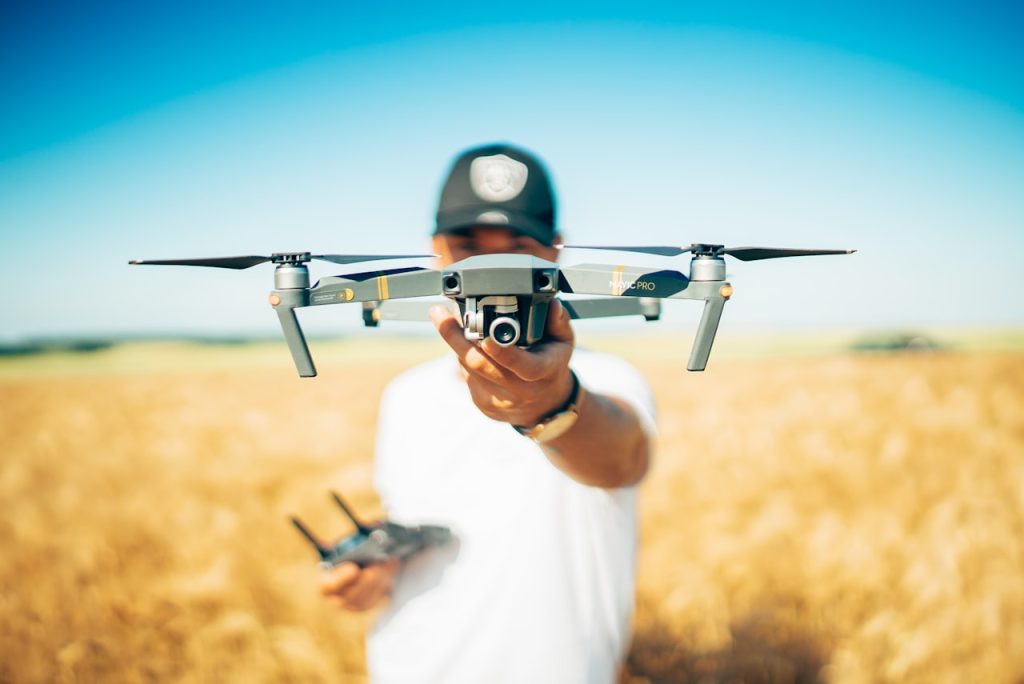
DJI owns the enterprise drone market on specs. The Matrice series, the Zenmuse payloads, the deep software ecosystem: it’s all there, well-supported and battle-tested across thousands of deployments. There’s one problem: for a growing class of US public safety and government operators, DJI is simply off the table. That opens a significant gap, and Autel has filled it with the EVO Max 4T.
The DoD Positioning That Actually Matters
Before getting into the hardware, context is required. Autel Robotics is not on the US Department of Defense’s list of Chinese military companies, the same list that’s driven restrictions on DJI equipment in US government and public safety procurement. That regulatory distinction, not marketing language, not spec comparisons, is the primary reason the EVO Max 4T is showing up in law enforcement fleets, fire service inventories, and utility inspection programmes across the United States.
When half your potential customers legally can’t buy the market leader, “not DJI” is a powerful position to occupy. Autel knows this. But the EVO Max 4T doesn’t rest on regulatory arbitrage alone. On the hardware, it has genuine substance.
Quad-Sensor Payload: The Defining Feature
The EVO Max 4T packages four distinct imaging capabilities into a single integrated gimbal assembly. No payload swaps. No choosing between thermal and RGB at mission briefing. Everything is available simultaneously:
- RGB zoom camera: 22x optical zoom, giving surveillance-grade reach for public safety and infrastructure work
- Wide-angle RGB camera: for situational awareness and full-scene context
- Thermal camera: 640×512 resolution with multiple palette modes
- Laser rangefinder: for precise GPS geolocation of targets
The laser rangefinder is the element that elevates this beyond a thermal drone. In search and rescue operations, knowing the exact GPS coordinates of a heat signature, rather than just its position in a video frame, changes how ground teams respond. It turns thermal imagery from a viewing capability into an actionable data feed. Incident commanders actually get useful numbers rather than a guess at bearing and distance.
Thermal Performance
The 640×512 thermal sensor sits at the high end of what’s available in this weight class. For search and rescue, whether finding a person in dense bush or locating a heat-stressed hiker at night, the resolution difference between 640×512 and a 320×240 sensor is real and measurable. You’re seeing more, interpreting more quickly, and making fewer wrong calls.
Infrastructure inspection benefits similarly. Powerline hotspots, solar panel defects, and rooftop heat loss assessment all get better results from higher thermal resolution. The palette modes (white-hot, black-hot, colour options) are adjustable per mission, and the picture-in-picture overlay lets operators view thermal and RGB zoom simultaneously in the controller interface without switching between feeds.
Low-Light and Night Operations
The EVO Max 4T includes a dedicated low-light camera alongside the thermal sensor. For law enforcement and search operations that run into darkness, which is most of them, this matters. Switching between thermal, low-light, and daylight RGB without landing for a payload swap is operationally significant. Single-sensor platforms can’t match this flexibility, and the operational time saved during active incidents adds up quickly.
Weather Resistance and Build Quality
IP43 weather resistance means the EVO Max 4T handles light rain and dusty conditions that would ground less capable hardware. It’s not fully waterproof, but it’s designed for real-world deployments where conditions don’t pause because the weather turned. Enterprise operations don’t wait for clear skies.
The airframe construction reflects an operational-reliability philosophy over consumer aesthetics. Quick-release propellers, modular payload connections, and purpose-built case transport: this is a drone designed to be pulled out of a fleet vehicle, deployed quickly, and brought back in reliable condition. That repeatability matters more to a fire service drone programme than whether the UI looks pretty.
Flight Time and Range
Autel rates the EVO Max 4T at approximately 42 minutes of flight time, competitive with DJI’s Matrice 30T in comparable configuration. Transmission range supports extended standoff distances appropriate for infrastructure inspection and wide-area search operations.
The Smart Controller is purpose-built for the EVO Max platform with real-time sensor switching, mission planning, and tracking modes integrated into the primary display. It’s not the most elegant interface in the market, but it’s functional and purpose-appropriate. Operators who’ve trained on it report the workflow becoming intuitive after relatively short familiarisation periods.
How It Stacks Up Against the Matrice 30T
The DJI Matrice 30T remains the most capable enterprise thermal drone on a straight spec comparison. Its thermal sensor, integration with FlightHub 2 fleet management, and ecosystem depth are hard to match. But for US public safety operators and government contractors operating under procurement restrictions, the Matrice 30T isn’t available. In that context, the EVO Max 4T isn’t competing with the Matrice 30T. It’s the only serious answer.
For international operators without procurement restrictions, the comparison is tighter. The Matrice 30T leads on software depth and ecosystem integration. The EVO Max 4T competes on hardware capability and, increasingly, on total cost of ownership. Autel’s enterprise support infrastructure has grown substantially as its US adoption has increased. A year ago this was a concern with the platform. It’s less of one now.
Pricing and Value for Public Safety
The EVO Max 4T is priced at enterprise levels. This isn’t a consumer purchase. The argument for the investment, particularly for public safety agencies, is total cost of ownership, not sticker price. A drone that replaces a manned helicopter deployment for a search operation, provides evidence-grade imagery for law enforcement, or enables rapid infrastructure survey at scale pays back the capital cost faster than most procurement committees expect.
For departments already in the market for enterprise thermal capability, the EVO Max 4T’s DoD-clear procurement status removes a compliance risk that following DJI equipment would create. That risk mitigation has value that shows up in reduced administrative overhead and procurement headaches, even if it doesn’t appear as a line item on a spec sheet.
Verdict
For US public safety and government operators, the Autel EVO Max 4T is the answer, both by default in restricted markets and on genuine hardware merit. The quad-sensor payload is the right tool for enterprise thermal missions. The 640×512 thermal resolution is strong. And the laser rangefinder integration makes it materially more useful in time-critical operations than a thermal-only platform.
If DJI were an option for your use case, this would be a closer call. For the large and growing share of the enterprise market where it isn’t, the EVO Max 4T is where you end up, and it earns that position rather than just inheriting it by default.