
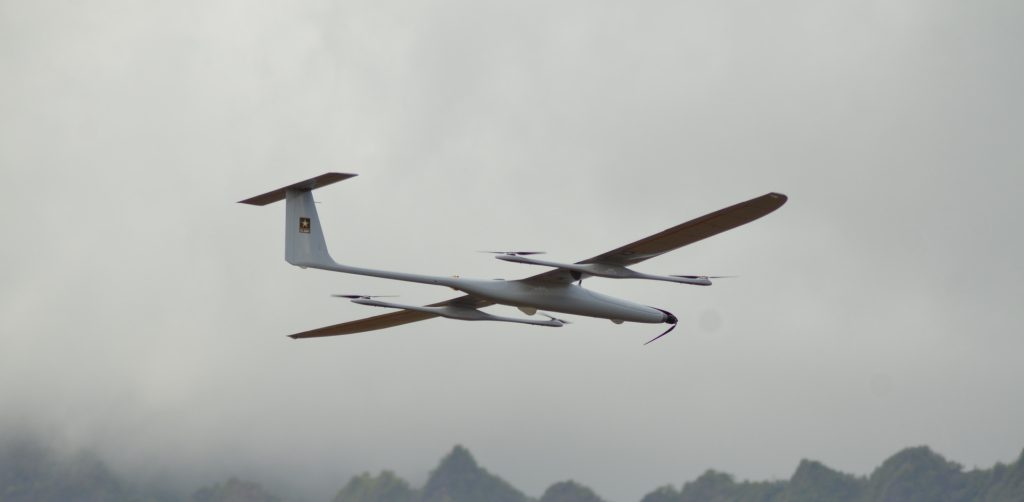
Kraus Hamdani Aerospace (KHA) confirmed that its K1000ULE unmanned aircraft system has been selected as part of a major U.S. Army Program of Record. The contract transitions the ultra-long-endurance platform from experimental and prototype evaluation into formal procurement for reconnaissance, surveillance, and target acquisition (RSTA) operations.
Platform Architecture and Specifications
The K1000ULE is a Group 2 unmanned aircraft system operating on an entirely electric powertrain. To achieve multi-day persistent flight without hydrocarbon fuel logistics, the airframe combines high-efficiency onboard batteries with solar cells integrated directly into the upper wing surfaces.
Key operational characteristics of the platform include:
- Takeoff and Recovery: Vertical takeoff and landing (VTOL) configuration, eliminating the requirement for runways, catapult launchers, or capture nets in forward operating areas.
- Acoustic and Thermal Footprint: Electric propulsion provides near-zero acoustic and thermal signatures compared to internal combustion engines in the same weight class.
- Mission Capabilities: Modular nose and payload bays engineered for electro-optical/infrared (EO/IR) sensors, electronic warfare suites, and airborne communications relay packages.
- Autonomy Stack: Onboard artificial intelligence algorithms manage power optimization, thermal management, and dynamic soaring routines to extend airborne dwell time.
Procurement and Defense Integration
The Program of Record selection follows a succession of military contract vehicles and vetting milestones secured by KHA. Earlier this year, U.S. Air Forces Central (AFCENT) awarded the company an indefinite-delivery/indefinite-quantity (IDIQ) contract to accelerate field deployments. The platform is also listed on the Defense Innovation Unit (DIU) Blue UAS Cleared and Select Lists and holds award-ready status through the Army Applications Laboratory DevX Autonomy marketplace.
By securing a formal Program of Record entry, the U.S. Army establishes a recurring procurement channel for Group 2 electric VTOL platforms. This shift reflects broader tactical priorities aimed at deploying persistent, low-signature intelligence assets closer to contested edge environments without expanding forward fuel supply chains.