
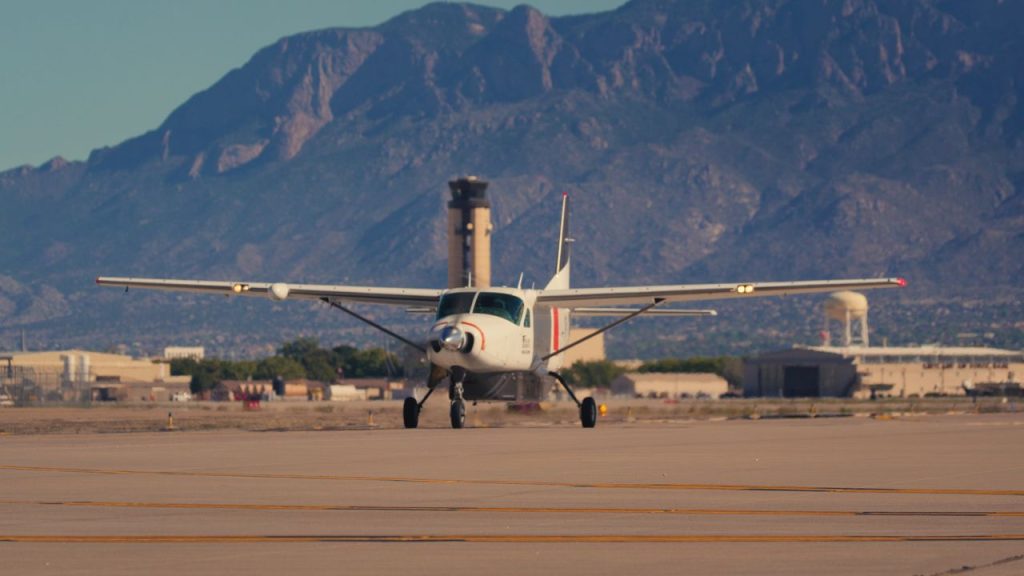
Reliable Robotics has completed its initial series of autonomous flight operations at Albuquerque International Sunport (ABQ), validating gate-to-gate uncrewed flight capabilities inside New Mexico’s busiest commercial and military joint-use airspace.
The flight test campaign was conducted under the United States Department of Transportation and Federal Aviation Administration’s Advanced Air Mobility Integration Pilot Program (eIPP). The City of Albuquerque Aviation Department is one of eight municipal entities selected nationally to evaluate how automated flight architectures integrate with existing air traffic control protocols.
Gate-to-Gate Airspace Integration
Testing centered on a modified Cessna 208B Grand Caravan utility aircraft retrofitted with the Reliable Autonomy System (RAS). During the multi-day deployment, the aircraft completed autonomous taxi, automated takeoff, pattern navigation, and automated landing sequences.
Supervision of the flight profile was distributed across two nodes: an onboard safety pilot seated in the cockpit for monitoring, and a remote pilot operating out of Reliable Robotics’ headquarters in Mountain View, California, located more than 700 miles away. The remote operator maintained continuous digital command-and-control links, communicating directly with local FAA air traffic controllers while issuing tactical flight guidance to the aircraft in real time.
Class C airspace environments present distinct operational friction for autonomous aviation due to rapid mix variations between scheduled commercial airliners, general aviation traffic, and transient military aircraft. Reliable’s test runs required zero structural alterations to standard National Airspace System procedures or ground airport infrastructure.
Sensor Architecture and Collision Avoidance
The core avionics suite driving the Caravan relies on a redundant software and hardware stack designed to address primary causes of aviation fatalities: loss of control in flight (LOC-I) and controlled flight into terrain (CFIT).
Collision mitigation is managed by an integrated Detect and Avoid (DAA) system that pairs proprietary pulse-Doppler radar hardware with the FAA’s Airborne Collision Avoidance System X (ACAS X) algorithms. The system continuously evaluates spatial separation relative to cooperative transponder-equipped traffic and non-cooperative airborne targets, computing autonomous evasive trajectories when separation minimums degrade.
Reliable Robotics currently holds an FAA-accepted certification basis and means of compliance for continuous autopilot engagement from taxi to touchdown, establishing a formal regulatory track for Part 23 and Part 135 operations.
Regional Air Cargo Deployment Trajectory
Data gathered during the Albuquerque campaign will feed directly into the commercial operating model for Reliable Airlines, the company’s wholly owned air cargo subsidiary. Under the next phase of the eIPP framework, the carrier intends to initiate pre-certification regional cargo routes connecting the Sunport hub to Durango-La Plata County Airport in Colorado and Santa Fe Regional Airport in New Mexico.
The operational validation arrives alongside a significant expansion in capitalization. Reliable recently secured an additional $115 million in capital, expanding its Series D financing round to $275 million and lifting company valuation above $1 billion. The funding is allocated toward expanding the automated Caravan fleet and staffing specialized radar and autonomy engineering facilities in Seattle and San Diego.