
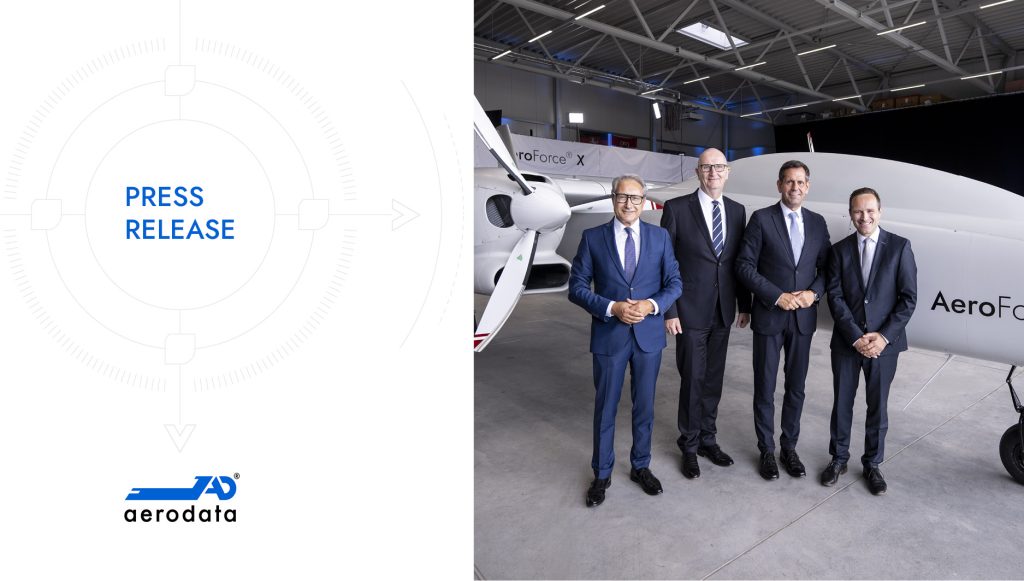
While European defense planners spend years lamenting their strategic dependence on foreign Medium Altitude Long Endurance (MALE) platforms and tangled US export restrictions, German aerospace specialist Aerodata AG has quietly built an actual airframe. The Braunschweig-based firm officially rolled out the first full-scale prototype of the AeroForce X at its Strausberg manufacturing facility in Brandenburg.
The aircraft represents a calculated entry into Europe’s sovereign surveillance architecture, designed to deliver high-end intelligence, surveillance, and reconnaissance (ISR) without relying on American supply chains or ITAR clearances.
Heavy Payload, Extended Endurance
The AeroForce X enters the MALE domain with specifications positioned directly against established global platforms like the MQ-9 Reaper and Hermes 900:
- Wingspan: 26 meters, optimized for high-altitude aerodynamic efficiency.
- Mission Endurance: Up to 40 hours of continuous airborne time on standard mission profiles.
- Payload Capacity: 1,300 kg total useful payload capacity, split between a 700 kg internal fuselage bay and two 325 kg wing hardpoints.
- Propulsion Layout: Twin-engine baseline design engineered with modular engine nacelles to accommodate alternate powerplant options based on customer operational requirements.
True ITAR-Free Architecture
The critical strategic differentiator of the AeroForce X lies in its regulatory posture. The platform is engineered from the ground up to be completely ITAR-free. Under standard United States International Traffic in Arms Regulations, European operators buying American airframes or sensor packages face stringent operational and resale restrictions. By designing both the airframe architecture and core sensor integration pathways independently in Germany, Aerodata eliminates foreign export vetoes for European and allied operators.
Multi-Domain Sensor and Mission Configurations
Aerodata has built mission integration packages for airborne surveillance, flight inspection, and maritime patrol for more than three decades. The AeroForce X leverages that background through a modular core fuselage architecture that supports rapid payload swapping across several military and civil domains:
- Maritime Patrol and ASW: High-payload configuration capable of carrying, deploying, and processing acoustic data from sonobuoy fields in real time for anti-submarine tracking.
- Signals Intelligence: Comprehensive ESM and ELINT suites capable of passive RF detection, emitter geolocation, and communications mapping over standoff ranges.
- Radar and Optical Surveillance: Integration of multi-mode maritime and ground-surveillance radar alongside stabilized multi-sensor EO/IR optical payloads.
- Kinetic Strike Options: Dedicated hardpoint configurations engineered to deploy loitering munitions against time-sensitive targets during protracted surveillance missions.
Development Timeline and Flight Test Schedule
Following the formal rollout in Strausberg in front of state leadership, the AeroForce X prototype enters ground-vibration and systems testing. The initial flight-test vehicle features an optionally piloted cockpit layout, allowing Aerodata flight engineers to evaluate handling qualities, powerplant telemetry, and mission systems with a safety pilot aboard later in 2026 before expanding the envelope to fully uncrewed autonomous operations.
For European defense forces seeking persistent domain awareness without diplomatic strings attached, the AeroForce X presents a pragmatic, flight-ready alternative to multinational procurement delays.