
Matternet: The Quiet Revolution in Autonomous Aerial Logistics
For more than a decade, the promise of drone delivery has occupied a space somewhere between high-tech fantasy and suburban skepticism. While global giants like Amazon and Alphabet have captured headlines with ambitious plans, a California-based company named Matternet has been methodically building the actual infrastructure that makes urban drone delivery a regulatory and operational reality. Founded in 2011, Matternet has shifted the conversation from “what if” to “where next,” focusing on high-value logistics where speed is not just a convenience, but a necessity.
The Matternet Ecosystem: Beyond the Aircraft
Unlike many competitors who focus solely on the drone, Matternet’s approach is systemic. The company recognizes that a drone is simply one link in a larger logistics chain. Their solution comprises three primary pillars: the M2 aircraft, the Matternet Landing Station, and a proprietary software platform. This integrated stack allows for a degree of automation that minimizes human intervention, which is critical for scaling operations in complex urban environments.
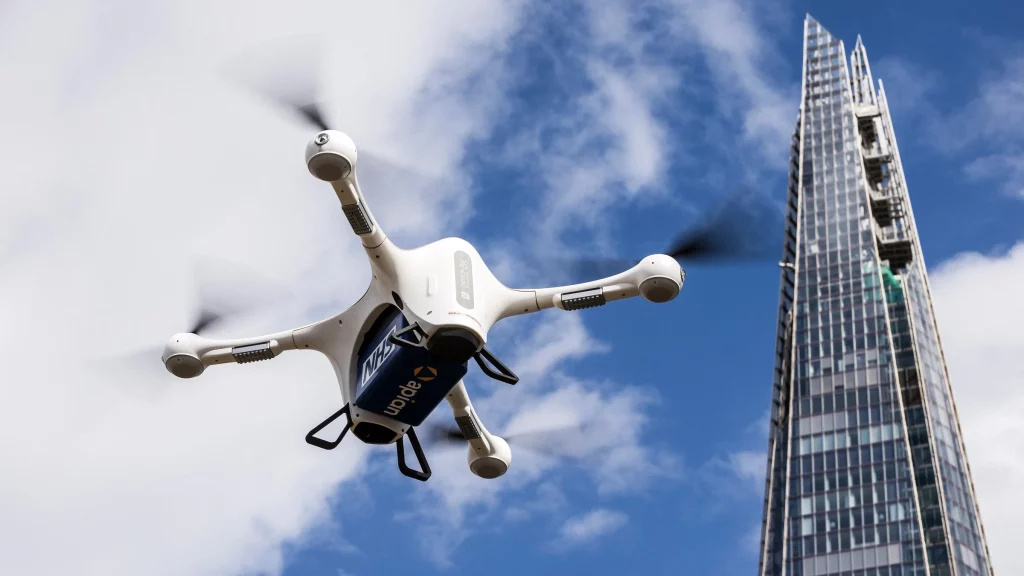
The M2 drone is the centerpiece of this system. It is a purpose-built quadcopter designed for the rigors of urban flight. With a payload capacity of 2 kilograms (approx. 4.4 pounds) and a range of up to 20 kilometers (12.4 miles), it is engineered for the “middle mile” and “last mile” of specialized delivery. Its most significant achievement, however, is not its battery life or speed, but its legal status. The M2 was the first delivery drone to receive a Type Certificate from the U.S. Federal Aviation Administration (FAA), a rigorous designation that essentially treats the drone as a commercial aircraft, subject to the same airworthiness standards as a Boeing 737 or a Cessna.
The Matternet Landing Station serves as the physical interface for these operations. It is an automated kiosk that manages the takeoff, landing, and cargo exchange. When a drone arrives, the station guides it to a precision landing, opens its hatch to receive the payload, and swaps the battery for a fully charged one. This automation allows for 24/7 operations without the need for a dedicated ground crew at every site, a prerequisite for any economically viable delivery network.
Establishing the Healthcare Foundation
Matternet’s strategic genius lay in its choice of initial markets. Rather than trying to deliver artisanal coffee to impulsive consumers, the company targeted the healthcare sector. In medical logistics, every minute saved can result in better patient outcomes. Transporting blood samples, pathology results, and emergency medications between hospital campuses often means navigating gridlocked city traffic. Matternet’s bypass of the street-level infrastructure offers a level of predictability and speed that ground transport cannot match.
In 2019, Matternet made history through a partnership with UPS, conducting the first revenue-generating drone flights in the United States at the WakeMed hospital campus in North Carolina. This was followed by significant expansions in Switzerland, where the company partnered with Swiss Post to connect hospitals in Zurich and Lugano. These operations provided the real-world data needed to convince regulators that autonomous drones could safely share the skies with manned aircraft.
2025 and 2026: The Global Expansion
The last eighteen months have marked a pivot from pilot programs to full-scale commercialization. In late 2025, Matternet signaled its entry into the consumer market by partnering with Dave’s Hot Chicken for a pilot program in Los Angeles. This move demonstrated that the system, refined in the high-stakes world of medical transport, was ready for the high-volume requirements of the fast-casual food industry.
The momentum continued into 2026. In April, Matternet launched operations in Central London, partnering with the NHS to connect two of the city’s busiest hospital campuses. Operating in one of the most congested and regulated airspaces in the world was a testament to the maturity of their technology. This was quickly followed by a strategic partnership with SoftBank Robotics America, aimed at scaling these networks across major U.S. metropolitan areas. By combining Matternet’s technical platform with SoftBank’s commercial expertise, the company is positioning itself to be the backbone of urban aerial logistics.
Technological Advancements and Strategic Partnerships
Innovation at Matternet is not confined to the flight controller. In May 2026, the company announced a partnership with Amprius to integrate high-density silicon anode battery cells into their next-generation platforms. These cells offer significantly higher energy density than traditional lithium-ion batteries, which will likely translate into increased range or payload capacity, further widening the gap between Matternet and its competitors.
Furthermore, the appointment of Sanjay Kotte, former Chief Commercial Officer for Robinhood Money and a veteran of DoorDash, to the Board of Directors suggests a looming aggressive expansion into the broader commerce sector. Kotte’s experience with large-scale restaurant brands and strategic partnerships aligns perfectly with Matternet’s goal of becoming a universal delivery utility.
The Regulatory Moat
Perhaps the most understated aspect of Matternet’s success is its “regulatory moat.” In a sector where many players are still operating under restrictive waivers or in rural test sites, Matternet holds the world’s only FAA Type Certification for a delivery drone. They have also secured a Production Certificate, allowing them to mass-produce the M2 drone in California. In Europe, the company holds the Light UAS Operator Certificate (LUC) from the Swiss Federal Office of Civil Aviation, which allows them to self-authorize operations across EASA member states.
These certifications are not just paperwork; they represent years of safety testing, software audits, and manufacturing quality control. For potential partners like UPS, Ameriflight, or the NHS, this regulatory readiness reduces the risk of adoption and provides a clear path to scale. Matternet isn’t just selling drones; they are selling a pre-approved method of logistics.
The Future: A Network for Matter
Matternet describes its vision as a “Network for Matter.” Just as the internet decentralized the flow of information, Matternet aims to decentralize the flow of physical goods. By moving logistics to the air, the company is effectively creating a new layer of urban infrastructure that is faster, cheaper, and more sustainable than the status quo.
As we look toward the end of the decade, the presence of the M2 drone in our city skies will likely become as unremarkable as the delivery truck is today. The transition from novelty to utility is well underway, driven by a company that chose to focus on the hard problems of regulation and reliability while the rest of the industry was busy chasing the hype. Matternet has proven that the future of delivery is not just aerial; it is autonomous, integrated, and already here.