
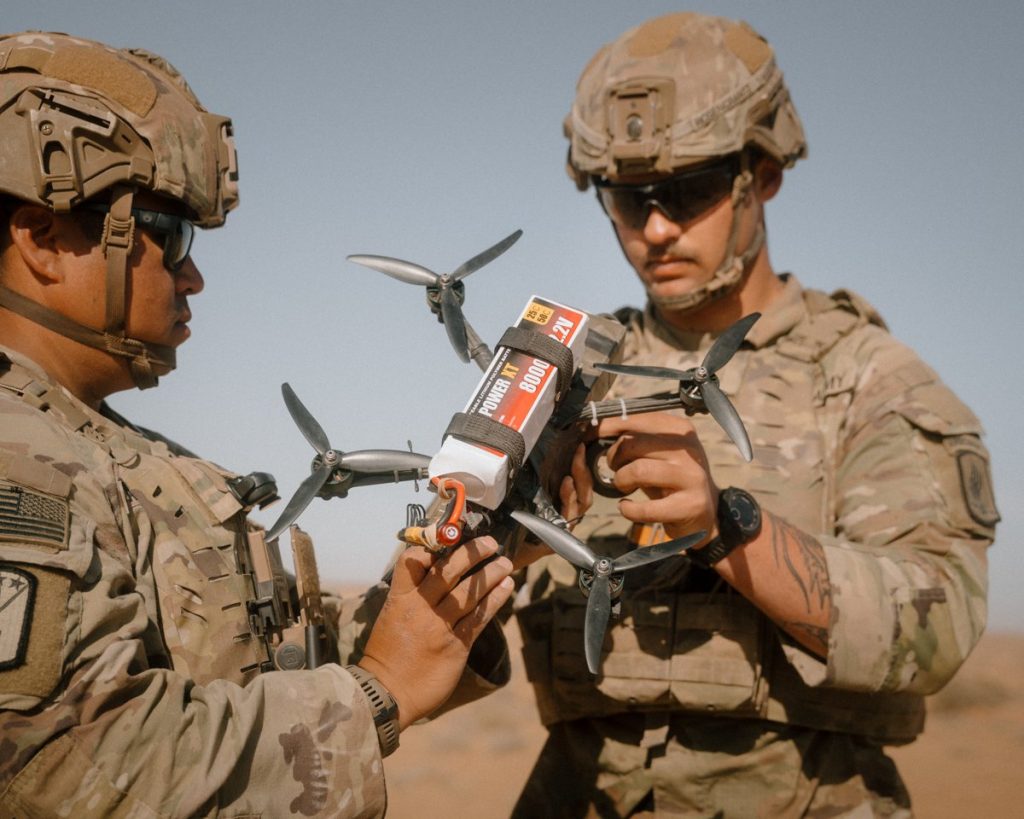
# The Gossamer Strike: How Fiber Optics Are Solving the Drone Jamming Crisis
The electronic landscape of the modern battlefield has become a graveyard for radio-controlled aircraft. In the ongoing conflict in Ukraine, the life expectancy of a standard FPV (First-Person View) drone is often measured in minutes, not hours. Between sophisticated electronic warfare (EW) suites or portable “jammers” mounted on individual vehicles, the wireless link between operator and machine has never been more fragile.
But a solution has emerged that seems almost primitive in its simplicity: a wire.
Fiber-optic drones, trailing gossamer-thin tethers of glass behind them, are rewriting the rules of uncrewed engagement. By bypassing the radio spectrum entirely, these systems have rendered traditional jamming irrelevant. This is not just a localized tactical shift; it is a fundamental reconfiguration of how autonomous systems operate in contested environments.
## The Radio Silence Problem
To understand the rise of fiber-optic drones, one must first understand the dominance of electronic warfare. For years, the primary counter to low-cost FPV drones has been frequency jamming. By flooding the control or video frequencies with noise, EW units can force a drone to lose its connection, crash, or hover helplessly until its battery dies.
Russia has deployed large EW arrays like the Krasuha-4, while Ukraine has responded with a dense network of portable jammers. The result is a perpetual game of “cat and mouse” where drone frequencies are constantly hopping and jammers are expanding their reach. Even the best pilots in the world cannot fly if their video feed is a wall of static.
Wireless links are inherently vulnerable. They emit a “signature” that can be tracked, leading enemies directly to the operator. They are subject to interference from terrain and buildings. But most importantly, they are susceptible to the one thing every army can now afford: a box that yells louder than your transmitter.
## The 20-Kilometer Leash
Wait, a wire? The idea sounds like something out of a Cold War museum. Early anti-tank missiles like the TOW used thin copper wires for guidance, but those systems were slow, limited in range, and prone to breaking.
Modern fiber optics are a different breed. Companies like 3DTech, a Ukrainian firm, have pioneered the Khyzhak REBOFF series of drones. These aircraft carry a spool of micro-thin fiber optic cable that unwinds as they fly. The results are staggering.
The latest REBOFF 13 models boast a range of 20 kilometers (roughly 12 miles). As the drone flies, the cable remains suspended in the air or drapes lightly over the terrain. Because the fiber is glass, it is lightweight and possesses incredible tensile strength for its size. More importantly, it can transmit high-definition video and control commands at the speed of light with zero latency.
## Why Fiber Wins
The advantages of a physical tether in a modern warzone are profound:
1. **Absolute Jam Resistance.** You cannot jam a wire with a radio frequency. Unless the cable is physically severed, the connection is perfect. The operator sees a crystal-clear 1080p feed even while flying directly over a Russian EW truck that would blind any other drone.
2. **Stealth and Security.** Because there is no radio transmission, the drone and the operator are electronically “dark.” There is no signal for Electronic Intelligence (ELINT) systems to triangulate.
3. **Bandwidth.** Wireless links are limited by the available spectrum. Fiber provides massive bandwidth, allowing for superior image quality that helps pilots distinguish between a real tank and a wooden decoy.
4. **Complex Environments.** Wireless signals struggle with “Non-Line-of-Sight” (NLOS) flight. Flying behind a hill or inside a concrete bunker usually ends the mission. With a fiber tether, the drone can navigate deep into tunnels or around urban corners without losing a single frame of video.
## The Tactical Trade-offs
Of course, flying with a miles-long leash is not without its challenges. The primary risk is the cable itself. It can snag on trees, power lines, or sharp debris. Pilots must be trained to fly in a way that avoids doubling back on their own line.
There is also the weight issue. Carrying several kilometers of glass adds mass, which reduces the flight time compared to a wireless equivalent. However, in the context of a strike mission where the goal is a one-way trip to a target, the trade-off is almost always worth it. A drone with a 15-minute flight time and a guaranteed connection is far more valuable than one with 30 minutes of “maybe.”
## Beyond the Frontline
While the military applications are obvious, the success of fiber-optic tethers should be a signal to the commercial sector as well. We are moving toward a world where the radio spectrum is increasingly crowded. In industrial environments (think nuclear plants, underground mines, or dense urban construction sites) the reliability of a physical data link is a significant asset.
We are seeing a rebirth of tethered systems for high-security inspections. When the risk of a signal drop-out could mean the loss of a $50,000 sensor package in a hazardous environment, a fiber-optic cable is much more than a leash; it is life insurance.
## Spooling Up the Future
The Khyzhak REBOFF is no longer just a prototype. The Ukrainian Ministry of Defense recently codified the series for official use, signaling a shift toward mass production. We are seeing a new era where “high-tech” does not necessarily mean “wireless.”
The history of technology is often a circle. We spent decades trying to cut the cord, only to realize that in the most demanding environments, the cord is exactly what we need. As the electronic war continues to escalate, the winners will be the ones who aren’t afraid to stay connected.
The gossamer thread is the new frontier of aerial dominance. It is thin, it is fragile, and it is currently the most unstoppable weapon in the sky.