
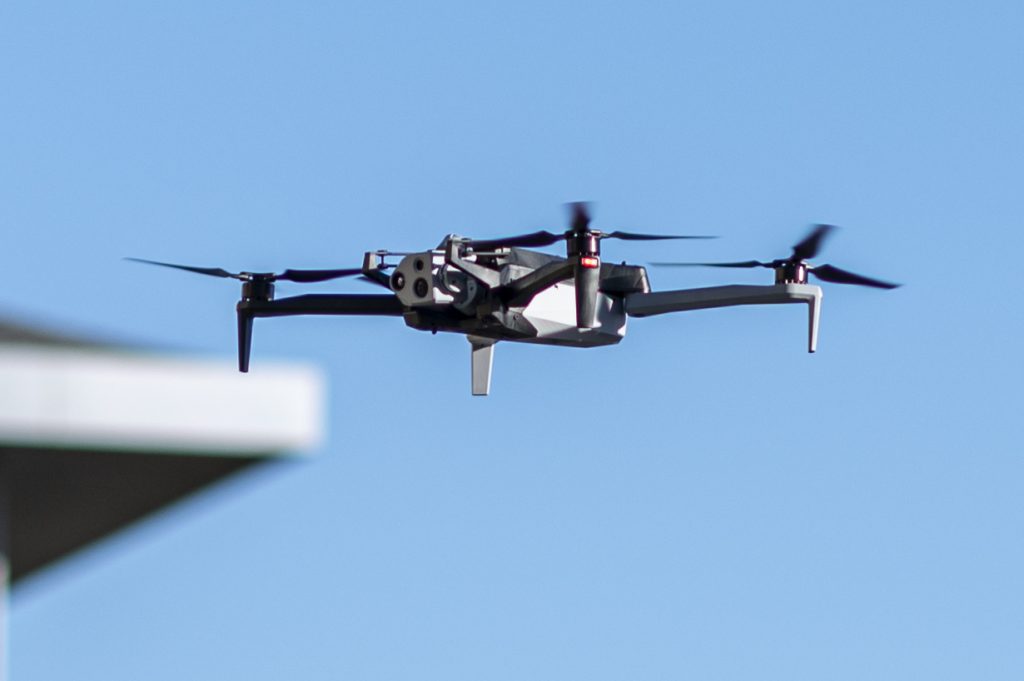
The Blue UAS Cleared List is the closest thing the United States has to an official approved drone registry. Managed by the Defense Contract Management Agency (DCMA) since July 2025, it names every unmanned aircraft system that has been vetted for U.S. Department of War procurement. No Chinese components. No Russian software. No exceptions.
As of early 2026, more than 50 platforms sit on that list. This article breaks down the most significant ones, compares their core specs, and explains what each is actually built for.
What Is the Blue UAS Cleared List?
Before Blue UAS existed, buying a drone for government use was slow. Units had to submit an Exception to Policy request for each specific operator, use case, location, and drone combination. That bottleneck made rapid deployment nearly impossible.
The program formally launched in August 2020, seeded by the U.S. Army’s Short Range Reconnaissance initiative and the FY2020 National Defense Authorization Act (NDAA). Section 848 of that Act banned components sourced from China, Russia, Iran, and North Korea. The Blue UAS program turned that requirement into a formal certification pathway.
To make the list, a drone must:
- Be free of critical components made in or by covered foreign countries
- Pass cybersecurity validation (via AUVSI’s Green List or a recognised third-party assessor)
- Be available for official DOW purchase
“Critical components” covers flight controllers, radios, cameras, gimbals, ground control systems, operating software, and data storage. A screw from overseas is fine. A Chinese flight controller is not.
This is why DJI, the world’s dominant consumer drone brand, cannot appear on this list. It is a subsidiary of a Chinese company, and that bars its products categorically regardless of where individual units roll off the production line.
Why This Matters Now
In late 2025, the FCC moved to block new foreign drone imports on a going-forward basis. That decision, combined with the existing NDAA restrictions, has made the Blue UAS list the de facto reference for any organisation that wants to fly commercially sourced drones without legal exposure.
State and local agencies increasingly reference the list when making procurement decisions. If a platform is Blue UAS cleared, it sidesteps weeks of compliance review.
The Key Platforms Compared
Here is a look at the most notable cleared platforms, grouped by category.
Best All-Around: Skydio X10D
Skydio holds more entries on the Select List than any other manufacturer, and the X10D is their flagship cleared platform. It started shipping to government customers in 2024 and has become the benchmark for what a Blue UAS platform can do.
Key specs:
- Weight: 2.11 kg (with battery)
- Max flight time: 40 minutes
- Range: 12 km (Connect SL)
- IP55 rated
- Obstacle avoidance: true 360 degrees
- Operating temp: -20C to +45C
Camera system: Three optical sensors plus a Teledyne FLIR Boson+ thermal imager. The wide camera uses a 1-inch 50.3MP sensor. The telephoto reaches 190mm equivalent. The thermal gives 640×512 resolution at less than 30mK sensitivity. That is a lot of imaging capability in one aircraft.
On the security side, the X10D runs AES-256 encrypted data links, trusted boot, and root of trust. The controller carries a 6.6-inch 1750-nit AMOLED screen that stays readable in direct sunlight.
If you need one cleared platform to do most things, this is it.
Best Compact Option: Parrot ANAFI USA
Parrot is a French company, but the ANAFI USA is built in the United States specifically to meet NDAA requirements. It has been on the cleared list for several years and remains one of the more accessible government-grade platforms.
Key specs:
- Weight: 485g
- Max flight time: 32 minutes
- Range: 4 km
- IP53 rated
- Max speed: 33 MPH
Camera system: Three cameras in one unit: a wide visual, a 32x zoom visual, and a 320 FLIR thermal sensor. For a sub-500g aircraft, the sensor package is unusually capable.
The ANAFI USA targets public safety and industrial inspection. It packs down small, flies fast enough for most field deployments, and gives operators thermal imaging without the weight or cost of larger platforms. Its main trade-off is range of 4 km puts a ceiling on longer-range operations.
Best Compact Recon: Teal Golden Eagle
Made by Teal (a Red Cat company), the Golden Eagle is built specifically for short-range reconnaissance. Combat soldiers, police officers, and first responders are its core users.
Key specs:
- Weight: 2.3 lbs (approx. 1 kg)
- Max flight time: 20-30 minutes
- Max speed: 50 MPH
- Wind resistance: 25 MPH
- Range: 1.86 miles (3 km)
- Max altitude: 2,000 feet AGL
Camera system: FLIR Hadron EO/IR unit with a 12.3MP CMOS sensor and 4K60 video capability. It combines optical and thermal imaging in a small housing suited to rapid deployment.
The Golden Eagle runs on a PX4 flight controller, operates from -32F to 110F, and has been designed to survive field conditions. Three variants sit on the cleared list: the Teal 2, the Golden Eagle at 1.8 GHz, and the Golden Eagle at 2.4 GHz.
Best Mid-Size Workhorse: Freefly Astro Max
Freefly Systems builds out of Austin, Texas, and the Astro Max is their cleared mid-size platform. It is built on 100,000+ commercial flights worth of development and positions itself as a flexible field tool for mapping, inspection, and public safety.
Key specs:
- Payload capacity: 3 kg
- Max flight time: 28-39 minutes (payload dependent)
- Open-architecture payload interface
- Compatible with LiDAR, thermal, and RGB mapping sensors
The Astro Max runs the Auterion mission suite and pairs with the Freefly Pilot Pro controller. Its open interface is one of its strongest selling points — operators can swap payloads without being locked into a single sensor ecosystem. The Blue-certified version uses NDAA-compliant components throughout.
Best Heavy Lift: Freefly Alta X (Blue Package)
When you need to put a serious payload in the air, the Alta X is the cleared answer. It is a large-frame octocopter designed for cinema, inspection, and industrial use cases that smaller platforms cannot handle.
Key specs:
- Maximum gross takeoff weight: 34.86 kg
- Maximum payload: 15.06 kg (33.2 lbs)
- Empty weight: 10.86 kg
- Unfolded diameter (with props): 2,273 mm
- Operating temp: -20C to +50C
The Alta X Blue Package swaps in a PX4 Blue Cube flight controller to meet DIU compliance requirements. It is not a small, portable platform, the folded footprint is still 877mm across, but nothing else on the cleared list comes close to its lift capacity.
Best FPV Option: ModalAI Seeker Vision FPV
ModalAI, based in San Diego, brought the FPV form factor into the cleared list in August 2025 with the Seeker Vision FPV (5-inch and 7-inch) and the Stinger Vision FPV. These are purpose-built for fast, close-quarters operations where conventional multirotor designs are too slow or too large.
The Seeker Vision FPV platforms are available in government-ready configurations and were added in response to DOW demand for smaller, faster cleared UAS options. ModalAI builds using NDAA-compliant components and has steadily expanded its cleared portfolio over the past two years.
Notable Fixed-Wing and VTOL Options
The cleared list is not limited to multirotor platforms.
Eagle NXT eBee TAC (agEagle Aerial Systems): A fixed-wing platform built for military mapping and area coverage. Fixed-wing endurance and efficiency at the cost of VTOL convenience.
Shield AI V-BAT: A vertical takeoff and landing fixed-wing drone. The V-BAT takes off and lands like a multirotor, then transitions to efficient fixed-wing cruise. It targets persistent ISR missions where endurance matters more than hover capability.
Anduril Ghost/Ghost-X: Built by Anduril Industries, these platforms sit at the more tactical end of the spectrum. The Ghost-X is designed for group-two UAS missions and runs Anduril’s Lattice autonomy software.
How the List Is Organised
The Blue UAS program actually has two tiers. The main Cleared List covers platforms that passed the standard On Ramp vetting process. The Select List covers platforms added through competitive processes or specific partner organisation needs, these carry a DIU-granted Authority to Operate (ATO). Skydio, for example, holds strong representation on the Select List.
The list transitioned from DIU to DCMA management in July 2025 following the Secretary of War memo titled “Unleashing U.S. Military Drone Dominance.” The full current list now lives at bluelist.dcma.mil.
What This Means for Commercial Buyers
The Blue UAS list was designed for government procurement, but it has become a useful reference for any commercial operator who needs to demonstrate that their aircraft has no foreign-adversary security exposure.
With the FCC’s 2025 import restrictions in place and DJI’s market position in limbo, cleared platforms have gained traction beyond purely government contexts. Critical infrastructure operators, utilities, and enterprise inspection teams are actively moving toward NDAA-compliant hardware.
The trade-off is cost. Blue-certified platforms carry a significant premium over commercial DJI equivalents. The Parrot ANAFI USA runs several thousand dollars. The Skydio X10D is an enterprise purchase. The Freefly Alta X in its Blue configuration is a professional tool with a professional price tag.
But if your operations require demonstrable compliance, or if you are working in environments where Chinese-origin hardware is a legal liability, these are currently the best options on the market.
Bottom Line
The Blue UAS Cleared List has grown from five platforms in 2020 to more than 50 by early 2026. The range now covers everything from a 485g folding compact to a 34 kg heavy-lift octocopter. There is a cleared option for most serious use cases.
For most government or compliance-sensitive deployments, the Skydio X10D sets the current standard. The Parrot ANAFI USA remains the most accessible multi-sensor option. And Freefly’s lineup covers the middle and upper end of the payload spectrum better than any other single manufacturer on the list.
The list updates on a rolling basis. If you are making a procurement decision, always cross-check the current entries at bluelist.dcma.mil before committing.